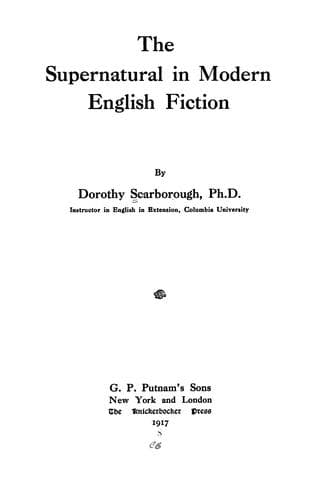
The Supernatural in Modern English FictionScarborough, Dorothy
History
The Supernatural in Modern English Fiction
Scarborough, Dorothy
English fiction -- History and criticism; Supernatural in literature
Perhaps the revival of interest in Elizabethan literature has had a
good deal to do with the use of supernatural beings in literature
of recent times. The devil and the dæmonic spirits he controls, the
witches and wizards, the vampires, the enchanted animals, to whom he
delegates a part of his infernal power, appear as impressive moral
allegories, mystical stories of life, symbols of truths. As literature
is a reflection of life, the evil as well as the good enters in. But
since the things of the spirit are intangible they must be represented
in concrete form, as definite beings whom our minds can apprehend. Thus
the poets and dramatists and story-makers must show us images to shadow
forth spiritual things. As with a shudder we close the books that tell
us horrifying tales of satanic spirits, of accursed beings that are
neither wholly animal nor human, of mortals with diabolic powers, we
shrink from the evils of the soul that they represent, and recognize
their essential truth in the guise of fiction.
CHAPTER V
Supernatural Life
The fiction dealing with immortal life shows, more than any other
aspect of the subject, humanity's deep hunger for the supernatural.
Whether it be stories of continuance of earthly existence without death
as in the legends of the undying persons like the Wandering Jew; or of
supernaturally renewed or preserved youth as described in the tales of
the elixir of life; or of the transference of the soul after death into
another body; or of life continued in the spirit in other worlds than
this after the body's death,--all show our craving for something above
and beyond what we know here and now. Conscious of our own helplessness
we long to feel ourselves leagued with immortal powers; shrinking
affrighted from the grave's near brink we yearn for that which would
spare us death's sting and victory. Sadly knowing with what swift,
relentless pace old age is overtaking us we would fain find something
to give us eternal youth. But since we cannot have these gifts in our
own persons we seek them vicariously in fiction, and for a few hours'
leisured forgetfulness we are endowed with immortal youth and joy. Or,
looking past death, we can feel ourselves more than conquerors in a
life beyond.
"Oh world unknowable, we touch thee!
Inapprehensible, we clutch thee!"
We somehow snatch a strange comfort from these stories of a life beyond
our own. We are comforted for our mortality when we see the tragedy
that dogs the steps of those who may not die, whether Swift's loathsome
Struldbrugs or the Wandering Jew. Our own ignorance of the future
makes us credulous of any man's dream of heaven and at the same time
sceptical of anybody else's hell. We are such indestructible optimists
that we can take any sort of raw material of fiction and transmute it
into stuff that hope is made of.
Public-domain text, read in full here on John Shaqi.
Reviews
Reviews
No reviews yet
Be the first to share your thoughts on this work.
Elsewhere in the archive
Join the Discussion
Join the discussion
Sign in to leave a comment or review.
Sign InorCreate an account