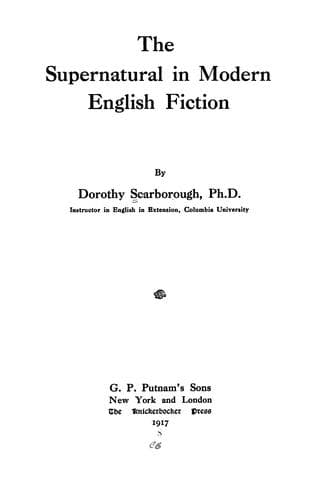
The Supernatural in Modern English FictionScarborough, Dorothy
History
The Supernatural in Modern English Fiction
Scarborough, Dorothy
English fiction -- History and criticism; Supernatural in literature
"Up stepped de debbil
Wid his iron wooden shubbil,
Tearin' up de yearth wid his big-toe nail!"
while to others he is an iconoclastic new thought. Heaven and
hell have been treated in every conceivable way in English
fiction--conventionally, symbolically, humorously, and satirically, so
that one may choose the type he prefers. There are enough kinds to go
around.
Among the portrayers of the traditional heaven and hell Mrs. Elizabeth
Stuart Phelps Ward is prominent. Her works on contemporary immortality
are said to have had a tremendous vogue in the period following
the Civil War, when death had claimed so many that the living were
thinking of the other world more than of this. Her pictures of heaven
in _Gates Ajar_ are comforting, for she assures to each person his own
dearest wish in fulfillment, to the ambitious youth his books, to the
young girl her piano, and to the small child her ginger-snaps instead
of earthly bread and butter. In _The Gates Between_ the physician,
suddenly killed, finds himself embarrassed by immortality. He doesn't
know how to adjust himself to eternity and at first brings many of
earth's problems with him. In the third of the series, _The Gates
Beyond_, she describes a very material yet spiritual heaven. Bodies are
much like those on earth, not vaporous projections; there are museums,
hospitals, universities, telephones, concerts and all up-to-date
improvements and conveniences. The dead woman discovers that she
remembers what she read on earth, takes pleasure in simple things such
as the smell of mignonette, hears the birds sing a Te Deum, while a
brook and a bird sing a duet, and the leaves are also vocal. There is a
Universal Language which must be learned by each soul, and heaven holds
all sorts of occupations, material, mental, and spiritual. She says
that near earth are many earth-bound spirits occupied in low and coarse
and selfish ways, who lack "spiritual momentum to get away." "They
loved nothing, lived for nothing, believed in nothing, they cultivated
themselves for nothing but the earth,"--which may be compared with the
state of the souls on Fifth Avenue, described by Granville Barker.
Mrs. Ward's pictures of heaven may seem sentimental and conventional to
us to-day, yet to be appreciated they must be considered in relation to
the religious thought of her time. She represented a reaction against
the rigid theology, the stern concepts of an older generation than
her own, and she wished to make heaven more homelike. She did have an
influence in her day, as may be illustrated by a remark from a sermon
recently delivered by a New York pastor, that the reading of her books
had exerted a great influence over him, that they made heaven over for
him.
Public-domain text, read in full here on John Shaqi.
Reviews
Reviews
No reviews yet
Be the first to share your thoughts on this work.
Elsewhere in the archive
Join the Discussion
Join the discussion
Sign in to leave a comment or review.
Sign InorCreate an account