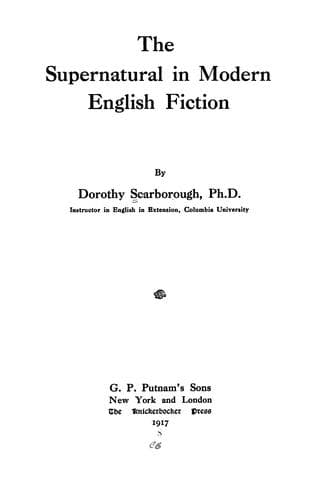
The Supernatural in Modern English FictionScarborough, Dorothy
History
The Supernatural in Modern English Fiction
Scarborough, Dorothy
English fiction -- History and criticism; Supernatural in literature
Interesting psychical material is found in a new volume of plays by
Theodore Dreiser.[172] He gives curious twists to the unearthly, as
in _The Blue Sphere_, where a shadow and a fast mail are among the
_dramatis personæ_, typifying the fate idea of the old drama. The
shadow lures a child monstrosity out on to the railway track, after
he has caused the elders to leave the gate open, and the train, made
very human, kills the child. The psychic effects in _In the Dark_
are even more peculiar, the characters including various spirits, a
wraith, and a ghost with red eyes, who circle round the human beings
and force them to discover a murder that has been committed. The effect
of supernatural manifestation on animals is brought out here, in the
bellowing of the bull and the howling of the dogs as the ghosts pass
by. In _A Spring Recital_ troops of nymphs and hamadryads, fauns,
clouds of loathsome spirits of hags and wastrels, "persistences" of
fish, birds, and animals, "various living and newly dead spirits
wandering in from the street," the ghost of an English minister of St.
Giles, who died in 1631, a monk of the Thebaid, of date 300 and three
priests of Isis of 2840 B.C. enter to hear the organist play. He is
unaware that anybody is hearing his music save the four human beings
who have happened in. These dramas of course are purely literary
plays, impossible of presentation on the stage, and in their curious
character show a likeness to some of the late German supernaturalism,
such as the plays of August Stramm. They show in an extreme form the
tendency toward psychic material that the American and English drama
has evidenced lately.
[172] _Plays of the Natural and the Supernatural._
=Life after Death.= Mankind is immensely interested in heaven and
hell, though he knows but little concerning these places. But man is
a born traveler and gives much thought to distant countries, whether
he definitely expects to go there or not. This interest is no new
thing, for classical mythology is full of doleful accounts of the
after life. The early English stage represented heaven and hell in
addition to the earth, and Elizabethan drama shows many references to
the underworld, with a strong Senecan influence. There are especially
frequent allusions to certain famous sufferers in Hades, as Ixion,
Tantalus, Sisyphus, and Tityus. Modern English fiction has likewise
been influenced by the epic supernaturalism, reflecting the heaven and
hell of Dante and Milton. Yet as in his own thinking each person lays
out a Celestial City for himself and pictures his own inferno to fit
his ideas of mercy and justice, peopling them with appropriate beings,
changing and coloring the conceptions of Bunyan, for instance, to suit
his own desires, so it is in fiction. Some think of heaven and hell as
definite places, while to others they are states of mind. To some the
devil is as real as in the darkey folk-song, where,
Public-domain text, read in full here on John Shaqi.
Reviews
Reviews
No reviews yet
Be the first to share your thoughts on this work.
Elsewhere in the archive
Join the Discussion
Join the discussion
Sign in to leave a comment or review.
Sign InorCreate an account