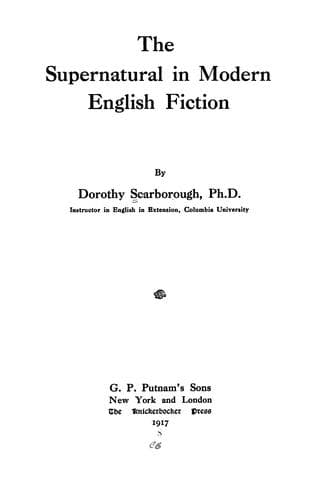
The Supernatural in Modern English FictionScarborough, Dorothy
History
The Supernatural in Modern English Fiction
Scarborough, Dorothy
English fiction -- History and criticism; Supernatural in literature
Little by little, in what seems the most spontaneous fiction, a
more comprehensive study of the sources of poetry and romance
begins to disclose a cause for each fancy, a story of inherited
materials from which each province of the poet's land has been
shaped and built over and peopled.
[189] In _Primitive Culture_, vol. i., page 273.
The Celtic Revival, the renascence of wonder in Ireland, has done more
than anything else to awaken modern love for antiquity, to bring over
into literature the legends of gods and men
"Beyond the misty space
Of twice a thousand years."
While the movement concerns itself more with poetry and the drama than
with prose,--Ireland has been likened to "a nest of singing birds,"
though the voices of some have been sadly silenced of late--yet fiction
has felt its influence as well. The land of the immortals glooms and
gleams again for us in storied vision, and the ancient past yields up
to us its magic, its laughter, its tears. These romances are written,
not in pedestrian prose as ordinary folk-tales, but with a bardic
beauty that gives to style the lifting wings of verse. Each fact and
figure is expressed in poetic symbols, which Yeats calls "streams of
passion poured about concrete forms." A sense of ancient, divine powers
is in every bush and bog, every lake and valley. Ireland has enriched
universal fancy and the effect on literature will perhaps never be lost.
* * * * *
One of the most interesting aspects of folk-loristic supernaturalism
is that concerned with nature. The primitive mind needs no scientific
proof for theories of causation, since, given a belief in gods, it can
manage the rest for itself. With the Celts there is ever a feeling
of nature as a mighty personality. Every aspect, every phase of her
power is endowed with life and temperament. Celtic pantheism saw in
every form a spirit, in every spring or cloud or hill-top, in every
bird or blossom some unearthly divinity of being. A primrose is vastly
more than a yellow primrose, but one of "the dear golden folk"; the
hawthorn is the barking of hounds, leek is the tear of a fair woman,
and so on, which poetic speech bears a likeness to the Icelandic court
poetry. This figurative sense suggests "an _after-thought_ of the old
nature-worship lingering yet about the fjords and glens where Druidism
never was quite overcome by Christianity." It lends to the Celtic
folk-tales their wild, unearthly beauty, their passionate poetry and
mystic symbolism akin to the classic mythology and such as we find in
no other folk-literature of the present time.
Public-domain text, read in full here on John Shaqi.
Reviews
Reviews
No reviews yet
Be the first to share your thoughts on this work.
Elsewhere in the archive
Join the Discussion
Join the discussion
Sign in to leave a comment or review.
Sign InorCreate an account