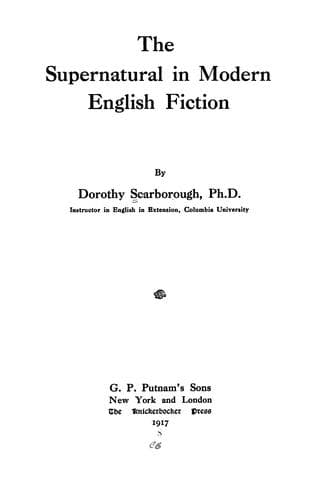
The Supernatural in Modern English FictionScarborough, Dorothy
History
The Supernatural in Modern English Fiction
Scarborough, Dorothy
English fiction -- History and criticism; Supernatural in literature
Certain forces of nature are given supernatural power in drama and
fiction, as the sea that is an awful, brooding Fate, in Synge's
drama, or the wind and the flame in Algernon Blackwood's story, _The
Regeneration of Lord Ernie_, or the goblin trees in another of his
tales, that signify diabolic spirits, or the trees[191] that have a
strange, compelling power over men, drawing them, going out bodily to
meet them, luring them to destruction. Blackwood has stressed this
form of supernaturalism to a marked degree. In _Sand_ he shows desert
incantations that embody majestic forces, evocations of ancient deities
that bring the Sphynx to life, and other sinister powers. He takes
the folk-loristic aspects of nature and makes them live, personifying
the forces of out-door life as mythology did. The trees, the sand,
the fire, the snow, the wind, the stream, the sea are all alive, with
personality, with emotion, and definite being. His trees are more
awesome than the woods of Dunsinane, for they actually do move upon
their foe. In _The Sea Fit_ he contends that the gods are not dead, but
merely withdrawn, that one true worshiper can call them back to earth,
especially the sea-gods. The sea comes in power for the man with the
Viking soul and takes him to itself. His going is symbolic.
Uttering the singing sound of falling waters, he bent forward,
turned. The next instant, curving over like a falling wave he swept
along the glistening surface of the sands and was gone. In fluid
form, wave-like, his being slipped away into the Being of the Sea.
[191] In _The Man Whom the Trees Loved_.
The uncanny potentialities of fire are revealed[192] where the internal
flame breaks out of itself, the inner fire that burns in the heart
of the earth and in men's hearts. The artist trying to paint a great
picture of the Fire-worshiper is consumed by an intense, rapturous
fever, and as he dies his face is like a white flame. The snow appears
embodied as a luring woman.[193] She tries to draw a man to his
death, with dæmonic charm, seen as a lovely woman, but a snow demon.
Blackwood shows the curious combination of the soul of a dead woman
with the spirit of a place,[194] where a man is ejected by his own
estate, turned out bodily as well as psychically, because he has become
out of harmony with the locale. Nature here is sentient, emotional,
possessing a child, expressing through her lips and hands a message of
menace and warning. The moon is given diabolic power in one of Barry
Pain's stories, and the maelstrom described by Poe has a sinister, more
than human, power. August Stramm, the German dramatist, has given an
uncanny force to the moor in one of his plays, making it the principal
character as well as the setting for the action. This embodiment of
nature's phases and phenomena as terrible powers goes back to ancient
mythology with a revivifying influence.
[192] In _The Heath Fire_.
[193] In _The Glamor of the Snow_.
Public-domain text, read in full here on John Shaqi.
Reviews
Reviews
No reviews yet
Be the first to share your thoughts on this work.
Elsewhere in the archive
Join the Discussion
Join the discussion
Sign in to leave a comment or review.
Sign InorCreate an account