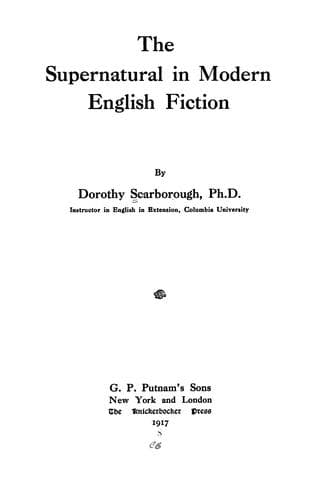
The Supernatural in Modern English Fiction — John Shaqi
The Supernatural in Modern English FictionScarborough, Dorothy
History
The Supernatural in Modern English Fiction
Scarborough, Dorothy
English fiction -- History and criticism; Supernatural in literature
The imagined ghost appears in many of the Gothic tales, whose writers
lack the courage of their supernaturalism. Mrs. Radcliffe, for
instance, loves to build up a tissue of ghostly horrors, yet explains
them away on natural grounds after the reader fancies he sees a spirit
around every corner.
The ghosts that are deliberately got up for the purposes of deception
form an interesting feature of Gothic methods. The reasons behind
the spectral impersonations are various, to frighten criminals into
restitution after confession, to further crime, or merely to enliven
the otherwise lagging story. In _The Spirit of Turrettville_ two youths
follow the sounds of plaintive music till, in a deserted, spookish
apartment, they see a woman playing at an old harp. As they draw near,
they see only skeleton hands on the keys and the apparition turns
toward them "a grinning, mouldering skull." She waves her hands with
haughty rebuke for their intrusion and "stalks" out of the oratory. She
gives further performances, however, singing a song composed for the
occasion. But the reader, after such thrills, resents finding out later
that she is the living wife, attempting to frighten the villain into
confession.
In _The Accusing Spirit_ a bogus spook is constructed by means of
phosphorus, aided by a strong resemblance between two men, to accuse
an innocent man of murder. The apparition dramatically makes his
charge, but is unmasked just in time to save the victim's life. A tall,
cadaverous young man makes up for a ghost in an anonymous novel,[15]
while a mysterious woman in a black veil attends a midnight funeral in
the castle, then unaccountably disappears.
[15] In _Ariel, or the Invisible Monitor_.
In _Melmoth_ the monks persecute a despised brother by impersonating
spirits in his cell. They cover the walls with images of fiends, over
which they smear phosphorus, and burn sulphur to assist the deception.
They utter mocking cries as of demons, seeking to drive him mad. In
Lewis's _Monk_ there is a false Bleeding Nun as well as the _bona
fide_ specter. In other Gothic novels there are various spectral frauds
cleverly planned, and then revealed, but their explanation does not
altogether dispel the uncanny impression they make.
The ghost that stays at home in a definite place, haunting its own
demesne, is a familiar figure in the fiction of the period. Every
castle has its haunted tower or dungeon or apartment with its shade
that walks by night. Several appear carrying candles or lamps to
light them through the blackness of architectural labyrinths. Several
evince a fondness for bells and herald their coming by rings. In one
romance,[16] the ghost takes the form of a white cow. (Doubtless many
ghosts in real life have had a similar origin.) In another,[17] a
specter in armor appears to terrify his murderer, and supernatural
lightning aids in his revenge.
[16] _The Spirit of the Castle._
Public-domain text, read in full here on John Shaqi.
Reviews
Reviews
No reviews yet
Be the first to share your thoughts on this work.
Join the Discussion
Join the discussion
Sign in to leave a comment or review.
Sign InorCreate an account