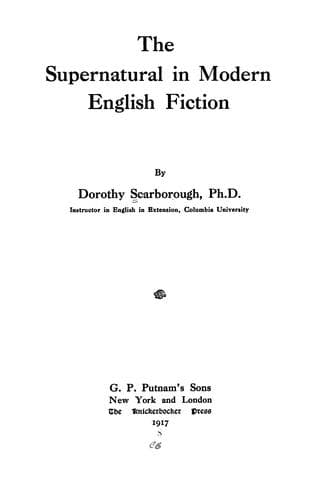
The Supernatural in Modern English FictionScarborough, Dorothy
History
The Supernatural in Modern English Fiction
Scarborough, Dorothy
English fiction -- History and criticism; Supernatural in literature
In _The Book of Wonder_ are still other gods, as Hlo-Hlo, who wears
the haloes of other gods on golden hooks along his hunting-belt;
the Sphinx, who "remembers in her smitten mind at which little boys
now leer, that she once knew well those things at which man stands
aghast"; the certain disreputable god who knows nothing of etiquette
and will grant prayers that no respectable god would ever consent to
hear; Chu-chu and Sheemish, who become angry with each other and raise
rival earthquakes that destroy their temple and them. We are told of
the Gibbelins that eat men, whose home is beyond the known regions, and
whose treasures many burglars try in vain to steal only to meet death
instead. Alderic tries a crafty way to evade them but they are waiting
for him. "And without saying a word _or even smiling_ they neatly hang
him on the outer wall,--and the tale is one of those that have not a
happy ending." But enough of gods!--though we should not forget the
Aztec legend on which Lew Wallace's novel, _The Fair God_, was founded,
of the white divinity who was to come and rule the people.
There are many other elements of folkloristic supernaturalism that
cannot be mentioned, as the banshee, the wailful creature that is a
presager of death and the loss of the soul; the fetches, ghosts of the
living, whom John and Michael Banim write much about; the pixies, as
appearing in such works as S. Baring-Gould's _Eve_, and Stephens's _The
Crock of Gold_; the mountain trolls that play pranks on Ibsen's Peer
Gynt and Irving's Rip van Winkle; the "worrie-cow" that Scott tells
about; the saints and miracles that abound in Celtic literature as in
that of any Catholic country, and such as Thomas A. Janvier has told
of so delightfully in his legends of the City of Mexico. The giant has
almost faded from fiction, since, poor thing, he doesn't fit in well
with the modern scheme of housing. He came into the Gothic novel from
the Oriental tale where he had his origin, but now he appears in our
fiction only sporadically, as in Oscar Wilde's _The Selfish Giant_,
in a couple of stories by Blackwood, and a few others. We are glad to
meet him occasionally in frank folk-tales since literature at large
repudiates this favorite of our youth. He would not suit well on the
stage, for obvious reasons, and realism rejects him.
Lord Dunsany tells of elves and gnomes, of the Moomoo, of the magic
sword called Mouse, of the gnoles that caught Tonker, of the ancient
Thuls, of the window that opened to the magic of the world, and of many
other things which only the very young or the very wise care for.
Public-domain text, read in full here on John Shaqi.
Reviews
Reviews
No reviews yet
Be the first to share your thoughts on this work.
Elsewhere in the archive
Join the Discussion
Join the discussion
Sign in to leave a comment or review.
Sign InorCreate an account