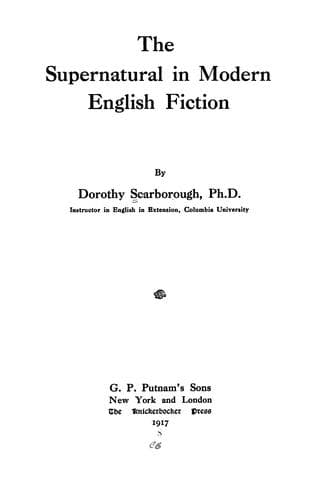
The Supernatural in Modern English FictionScarborough, Dorothy
History
The Supernatural in Modern English Fiction
Scarborough, Dorothy
English fiction -- History and criticism; Supernatural in literature
Arthur Machen deals with strange, sinister aspects of supernaturalism
unlike the wholesome folklore that other writers reveal to us. He seems
to take his material chiefly from the Pit, to let loose upon the world
a slimy horde of unnamable spirits of ageless evil. One reads of the
White People, who are most loathsome fairies under whose influence the
rocks dance obscene dances in the Witches' Sabbath, and the great white
moon seems an unclean thing. Images of clay made by human hands come
to diabolic life, and at mystic incantations the nymph Alanna turns
the pool in the woodland to a pool of fire. In _The Great God Pan_ the
timeless menace comes to earth again, corrupting the souls of men and
women, rendering them unbelievably vile. In _The Red Hand_ he brings
together ancient runes with magic power, black stones that tell secrets
of buried treasure, flinty stone like obsidian ten thousand years old
that murders a man on a London street, a whorl of figures that tell of
the black heaven, giving an impression of vast ages of enigmatic power.
One feels one should rinse his mind out after reading Arthur Machen's
stories, particularly the collection called _The Three Impostors_.
This discussion has taken more note of the Celtic folk-fiction than
of any other group influence, because more than any other it has left
its imprint on modern literature. There are hundreds of volumes of
folk-tales of the supernatural in English, but the Celtic Revival has
molded its legends into literature that is its own excuse for being.
In the work of this school we get a passionate mysticism, a poetic
symbolism that we find scarcely anywhere else in English prose, save
in such rhapsodic passages as some of De Quincey's impassioned prose.
Melody, which forms so large a part of the effect of supernaturalism
in poetry, is here employed to heighten lyric prose. Some of the wild
stories are like the croon of the peasant mother by her cradle beside
the peat-fire, some like wild barbaric runes of terrible unguessed
import, some like the battle-cry of hero-gods, some like the keening of
women beside their dead. The essential poetry of the Celtic soul pours
itself forth in rapturous, wistful music, now like a chant, a hymn, a
wedding-song, a lament for the lost soul.
In the Celtic folk-tales we get a mixture of romances, of the survivals
of barbaric days, the ancient druid myths, the pagan legends, savage
beliefs overlaid and interwoven with the later Christian traditions.
Sometimes the old pagan myths themselves become moral allegories,
the legend being used to tell a late-learned moral truth. But, for
the most part, there is no attempt at teaching save that which comes
spontaneously, the outburst of passionate, poetic romance, the heritage
of a people that love wonder and beauty.
Public-domain text, read in full here on John Shaqi.
Reviews
Reviews
No reviews yet
Be the first to share your thoughts on this work.
Elsewhere in the archive
Join the Discussion
Join the discussion
Sign in to leave a comment or review.
Sign InorCreate an account