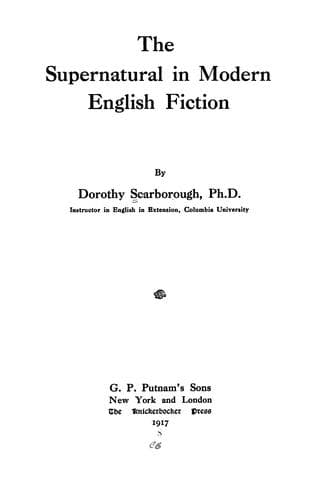
The Supernatural in Modern English FictionScarborough, Dorothy
History
The Supernatural in Modern English Fiction
Scarborough, Dorothy
English fiction -- History and criticism; Supernatural in literature
swallow the wildest improbability if the bait be labeled science or
psychical research. No supernaturalism is incredible if it is expressed
in technical terminology, and no miracle will be rejected if its
setting be in a laboratory. One peculiar thing about modern scientific
thought in its reaction upon fiction is that it is equally effective in
realism, such as shown in the naturalistic novels of Zola, the plays
of Brieux and others, and in supernaturalism, as in the work of H. G.
Wells, for instance, where the ghostly is grafted on to cold realism.
The transition from the sorcerer, the wizard, the warlock of older
fiction to the scientist in the present has been gradual. The sorcerer
relied wholly upon supernatural, chiefly diabolic, agencies for his
power, while the wizard of the modern laboratory applies his knowledge
of molecules and gases to aid his supermortal forces. Modern science
itself seems miraculous, so its employment in ghostly stories is
but natural. The _Arabian Nights' Tales_ seem not more marvelous
than the stories of modern investigations. Hawthorne's narratives
stand between the old and the new types of science, his Rappaccini,
Dr. Heidigger, Gaffer Dolliver, Septimius Felton and his rivals in
search for the elixir of youth, as well as the husband who sought to
efface the birthmark from his young wife's cheek, being related in
theme to the older conventional type and in treatment to the new.
Poe's scientific stories are more modern in method and material, and
in fact he made claim of originality of invention for the idea of
making fiction plausible by the use of scientific laws. His _Descent
into the Maelstrom_, _MS. Found in a Bottle_, and other stories were
novel in the manner in which they united the scientifically real and
the supernatural. _The Pit and the Pendulum_, with its diabolical
machinery, is akin to the modern mechanistic stories rather than to
anything that had preceded it. Poe paved the way for H. G. Wells's use
of the ghostly mechanical and scientific narratives, as his stories
of hypnotism with its hideous aftermath of horror must have given
suggestion for Arthur Machen's revolting stories of physical operations
with unearthly consequences. An example of the later manifestations of
supernaturalism in connection with science is in Sax Rohmer's tales
of Fu-Manchu, the Chinese terror, the embodied spirit of an ancient
evil that entered into him at his birth, because of his nearness to an
old burying-ground, and who, to his unholy alliance unites a wizard
knowledge of modern science in its various aspects. With every power of
cunning and intellect intensified, with a technical knowledge of all
means with which to fight his enemies, he ravages society as no mere
sorcerer of early fiction could do.
Public-domain text, read in full here on John Shaqi.
Reviews
Reviews
No reviews yet
Be the first to share your thoughts on this work.
Elsewhere in the archive
Join the Discussion
Join the discussion
Sign in to leave a comment or review.
Sign InorCreate an account