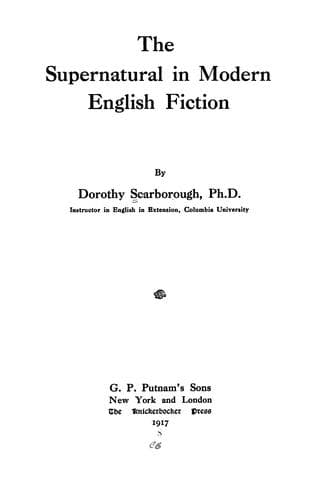
The Supernatural in Modern English FictionScarborough, Dorothy
History
The Supernatural in Modern English Fiction
Scarborough, Dorothy
English fiction -- History and criticism; Supernatural in literature
A certain supernatural element of style seems to lend itself to some
of the writers of strange fiction. Some of Oscar Wilde's sentences
unfold like wild, exotic flowers, in a perfumed beauty that suggests a
subtle poison at the heart. Lord Dunsany writes joyously of fantastic
creatures with a happy grace, sometimes like a lilting laugh, sometimes
a lyric rhapsody. His evoked beings are sportive or awesome but never
unclean. Arthur Machen's stories have an effect like a slimy trail
of some loathly beast or serpent. William Morris's style is like an
old Norse rune, while Algernon Blackwood makes us think of awakened,
elemental forces hostile to man. We feel bodiless emotions, feelings
unclothed with flesh, sad formless spirits blown on the winds of the
world. These folk-tales reflect the sweet carelessness of the Irish
soul, the stern sadness of the Scotch, the psychic subtlety of the
modern English. And as the study of folk-lore has influenced the
fiction of the supernatural, so these published romances have aroused a
wondering interest in the legendry of the past and made of folk-lore a
science.
CHAPTER VII
Supernatural Science
The application of modern science to supernaturalism, or of the
supernatural to modern science, is one of the distinctive features
of recent literature. Ghostly fiction took a new and definite turn
with the rapid advance in scientific knowledge and investigation in
the latter part of the nineteenth century, for the work of Darwin,
Spencer, Huxley, and their co-laborers did as much to quicken thought
in romance as in other lines. Previous literature had made but scant
effort to reflect even the crude science of the times, and what
was written was so unconvincing that it made comparatively little
impress. Almost the only science that Gothic fiction dealt with, to
any noticeable extent, was associated with alchemy and astrology. The
alchemist sought the philosopher's stone and the elixir of life while
the astrologer tried to divine human destiny by the stars. Zofloya
dabbled in diabolic chemistry, and Frankenstein created a man-monster
that was noteworthy as an incursion into supernatural biology, yet
they are almost isolated instances. Now each advance in science has
had its reflection in supernatural fiction and each phase of research
contributes plot material, while some of the elements once considered
wholly of the devil are now scientific. The sorcerer has given place
to the bacteriologist and the botanist, the marvels of discovery have
displaced miracles as basis for unearthly plot material, and it is
from the laboratory that the ghostly stories are now evolved, rather
than from the vault and charnel-room as in the past. Science not only
furnishes extraordinary situations for curdling tales, but it is an
excellent hook to hang supernatural tales upon, for it gives an excuse
for believing anything, however incredible. Man is willing to accept
the impossible, if he be but given a modern excuse for it. He will
Public-domain text, read in full here on John Shaqi.
Reviews
Reviews
No reviews yet
Be the first to share your thoughts on this work.
Elsewhere in the archive
Join the Discussion
Join the discussion
Sign in to leave a comment or review.
Sign InorCreate an account