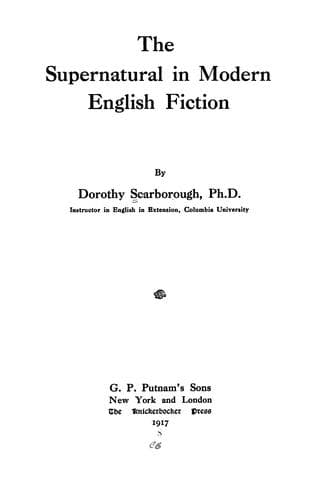
The Supernatural in Modern English FictionScarborough, Dorothy
History
The Supernatural in Modern English Fiction
Scarborough, Dorothy
English fiction -- History and criticism; Supernatural in literature
_The Remarkable Case of Davidson's Eyes_, by H. G. Wells, is an
interesting example of this new scientific transference of magic
vision. Davidson is working in a laboratory which is struck by
lightning, and after the shock he finds himself unable to visualize
his surroundings, but instead sees the other side of the world, ships,
a sea, sands. The explanation given by a professor turns on learned
theories of space and the Fourth Dimension. He thinks that Davidson,
in stooping between the poles of the electro-magnet, experienced a
queer twist in his mental retinal elements through the sudden force
of the lightning. As the author says: "It sets one dreaming of the
oddest possibilities of intercommunication in the future, of spending
an intercalary five minutes on the other side of the world, of being
watched in our most secret operations by unexpected eyes." Davidson's
vision comes back queerly, for he begins to see the things around him
by piecemeal, as apparently the two fields of vision overlap for a time.
Brander Matthews in _The Kinetoscope of Time_ introduces an instrument
with eyepieces that show magic vision. The beholder sees scenes from
the past, from literature as well as from life, has glimpses of Salome
dancing, of Esmerelda, witnesses the combat between Achilles and
Hector, the tourney between Saladin and the Knight of the Leopard. The
magician offers to show him his future--for a price--but he is wise
enough to refuse.
Magic views of the future constitute an interesting aspect of the
supernatural vision in modern stories. _The Lifted Veil_, by George
Eliot, is an account of a man who has prophetic glimpses of his fate,
which seem powerless to warn him, since he marries the woman who
he knows will be his doom, and he is aware that he will die alone,
deserted even by his servants, yet cannot help it. He sees himself
dying, with the attendants off on their own concerns, knows every
detail beforehand, but unavailingly. This suggests _Amos Judd_, by
J. A. Mitchell, which is a curious instance of the transition stage of
second sight, related both to the old sorcerer type and to the new
scientific ideas. Amos Judd, so called, is the son of an Indian rajah,
sent out of his country because of a revolution, and brought up in
ignorance of his birth in a New England farmhouse. Vishnu, in the far
past, has laid his finger on the brow of one of the rajah's ancestors,
thereby endowing him with the gift of magic vision, which descends
once in a hundred years to some one of his line. Amos Judd therefore,
can see the future by pictures, beholding clearly everything that will
happen to him. He sees himself lying dead at a desk, on which stands a
calendar marking the date, November 4th. His friends persuade him to
live past the date, and they think all is well, till one day while he
is on a visit to a strange house he is killed by an assassin. They find
him lying at a desk, with an out-of-date calendar beside him, marking
November 4th.
Public-domain text, read in full here on John Shaqi.
Reviews
Reviews
No reviews yet
Be the first to share your thoughts on this work.
Elsewhere in the archive
Join the Discussion
Join the discussion
Sign in to leave a comment or review.
Sign InorCreate an account