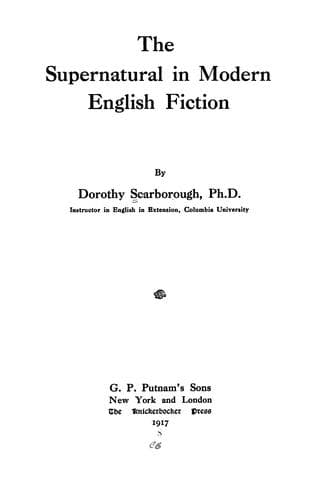
The Supernatural in Modern English FictionScarborough, Dorothy
History
The Supernatural in Modern English Fiction
Scarborough, Dorothy
English fiction -- History and criticism; Supernatural in literature
Barry Pain endows a bulldog with the power to foretell the future, to
reveal disaster and oppose it. Zero, in the story by that name, is a
common bulldog greatly valued because he has a supernatural knowledge
of any evil that threatens those he loves, and by his canine sagacity
he forestalls fate. In the end, in protecting his master's little
child, he is bitten by a mad dog, whose coming he has supernaturally
foreseen, and he commits suicide as the only way out of the difficulty.
Arthur Machen, in _The Bowmen and Others_, tells varied stories of
supernatural vision associated with the war.
_The Door in the Wall_, by H. G. Wells, depicts a man who in his
dreamy childhood wanders into a secret garden where he is shown the
book of his past and future, but who afterwards is unable to find the
door by which he enters, though he seeks it often. Later in life,
at several times when he is in a special haste to reach some place
for an important appointment, he sees the door, but does not enter.
Finally he goes in to his death. This is an instance of the suggestive
supernaturalism associated with dreams and visions.
The use of mirrors in supernatural vision is significant and appears
in a number of ways in modern fiction. Scott's _My Aunt Margaret's
Mirror_ is an early instance, where the magician shows the seeker
a glass wherein she sees what is taking place in another country,
sees her husband on his way to the altar with another woman, sees a
stranger stop the marriage, and witnesses the fatal duel. Hawthorne
has used mirrors extensively as symbolic of an inner vision, of a look
into the realities of the soul. For instance, when poor Feathertop,
the make-believe man, the animated scarecrow, looks into the mirror
he sees not the brave figure the world beholds in him, but the thing
of sticks and straw, the sham that he is, as the minister shrinks
from the mirrored reflection of the black veil, symbol of mystery
that he wears. Hawthorne elsewhere speaks of Echo as the voice of the
reflection in a mirror, and says that our reflections are ghosts of
ourselves. Mr. Titbottom, in George William Curtis's _Prue and I_,
who has the power of seeing into the souls of human beings by means
of his magic spectacles and catching symbolic glimpses of what they
are instead of what they appear to be, beholds himself in a mirror
and shrinks back aghast from the revelation of his own nature. Barry
Pain's story, referred to in another connection, shows a mirror wherein
a supernatural visitant reveals to a young man the supreme moments of
life, his own and those of others, pictures of the highest moments of
ecstasy or despair, of fulfillment of dear dreams.
Public-domain text, read in full here on John Shaqi.
Reviews
Reviews
No reviews yet
Be the first to share your thoughts on this work.
Elsewhere in the archive
Join the Discussion
Join the discussion
Sign in to leave a comment or review.
Sign InorCreate an account