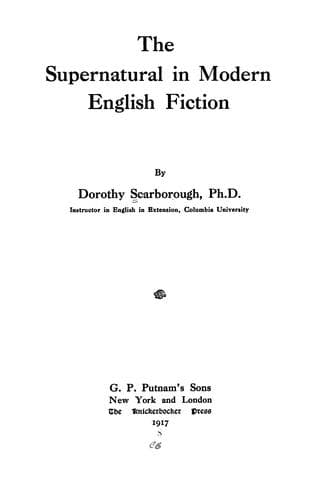
The Supernatural in Modern English FictionScarborough, Dorothy
History
The Supernatural in Modern English Fiction
Scarborough, Dorothy
English fiction -- History and criticism; Supernatural in literature
Mary Wilkins Freeman deals with the Fourth Dimension in _The Hall
Bedroom_, where the boarder drifts off into unknown space, never to
return, from gazing at a picture on the wall, as has happened in the
case of previous occupants of the room. Richard Middleton employs
the same idea in a story of a conjurer who nightly plays a trick in
public, causing his wife to seem to disappear into space. One night she
actually does so vanish, never to be seen again. Other instances of the
form may be found in recent fiction. H. G. Wells uses the theme with
a different twist in his _Time Machine_. Here the scientist insists
that time is the Fourth Dimension, that persons who talk of the matter
ordinarily have no idea of what it is, but that he has solved it. He
constructs a machine which enables him to project himself into the
future or into the past, and sees what will happen or what has happened
in other centuries. He lives years in the space of a few moments
and has amazing adventures on his temporal expeditions. But finally
the Fourth Dimension, which may be thought of as a terrible Fate or
inescapable destiny awaiting all who dally with it, gets him too, for
he fails to return from one of his trips. Another story tells of a man
who by drinking quantities of green tea could project himself into the
Fourth Dimension.
A number of stories of scientific supernaturalism are concerned with
glimpses into the future. _The Time Machine_, just mentioned, with
its invasions of the unknown space and time, its trips into eternity
by the agency of a miraculous vehicle, illustrates the method. The
scientist finds that he can travel backwards or forwards, accelerating
or retarding his speed as he will, and get a section of life in any age
he wishes. He discovers that in the future which he visits many reforms
have been inaugurated, preventive medicine established, noxious weeds
eradicated, and yet strange conditions exist. Mankind has undergone
a two-fold involution, the soft conditions of life having caused the
higher classes to degenerate into flabby beings of no strength, while
an underground race has grown up of horrible depraved nature, blind
from living in subterranean passages, cannibalistic while the others
are vegetarian. The lower classes are like hideous apes, while the
higher are effeminate, relaxed. The traveler escapes a dire fate only
by rushing to his machine and returning to his own time. Samuel Butler
suggests that machines will be the real rulers in the coming ages, that
man will be preserved only to feed and care for the machines which
will have attained supernatural sensibility and power. He says that
mechanisms will acquire feelings and tastes and culture, and that man
will be the servant of steel and steam in the future, instead of master
as now; that engines will wed and rear families which men, as slaves,
must wait upon.
Public-domain text, read in full here on John Shaqi.
Reviews
Reviews
No reviews yet
Be the first to share your thoughts on this work.
Elsewhere in the archive
Join the Discussion
Join the discussion
Sign in to leave a comment or review.
Sign InorCreate an account