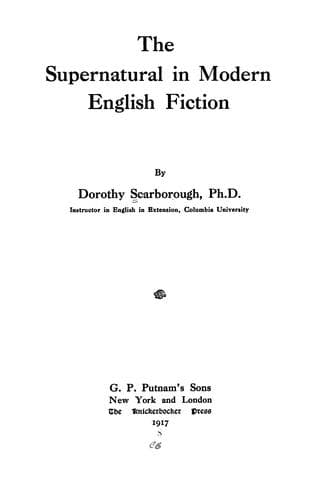
The Supernatural in Modern English FictionScarborough, Dorothy
History
The Supernatural in Modern English Fiction
Scarborough, Dorothy
English fiction -- History and criticism; Supernatural in literature
Views of other planets form a feature of modern supernaturalism, for
the writer now sets his stories not only on earth, in heaven, and in
hell but on other worlds besides. The astrologer of ancient fiction,
with his eye fixed ever on the stars, seeking to discern their
influence on human destiny, appears no more among us. He has been
replaced by the astronomer who scans the stars yet with a different
purpose in fiction. He wishes to find out the life of citizens of
other planets rather than to figure out the fate of mortals on the
earth. Many stories of modern times cause new planets to swim into our
literary ken and describe their citizens with ease. H. G. Wells stars
here as elsewhere. In his _War of the Worlds_ he depicts a struggle
between the earth people and the Martians, in which many supernatural
elements enter. The people of Mars are a repulsive horde of creatures,
yet they have wonderful organization and command of resources, and
they conquer the earth to prey upon it. This book has suffered the
inevitable parody.[200] In _The Crystal Egg_, Wells describes a curious
globe in which the gazer can see scenes reflected from Mars. The author
suggests two theories as to the possibility of this,--either that
the crystal is in both worlds at once, remaining stationary in one
and moving in the other, and that it reflects scenes in Mars so that
they are visible on earth, or else that by a peculiar sympathy with
a companion globe on the other planet it shows on its surface what
happens in the other world. It is hinted that the Martians have sent
the crystal to the earth in order that they might catch glimpses of our
life.
[200] In _The War of the Wenuses_, by C. L. Graves and E. V.
Lucas.
In _The Star_, Wells gives yet another story of the future, of other
planetary influences. By the passing of a strange star, life on earth
is convulsed and conditions radically changed. These conditions are
observed by the astronomers on Mars, who are beings different from
men, yet very intelligent. They draw conclusions as to the amount of
damage done to the earth, satirizing human theories as to Mars. _The
Days of the Comet_ shows earthly life changed by the passing of a
comet, but instead of the destruction described in the other story, the
social conditions are vastly improved and a millennium is ushered in.
Wells[201] makes a voyage to the moon possible by the discovery of a
substance which resists gravity. Other instances might be given, for
there has been no lack of lunar literature, but they are not usually
worth much.
[201] In _The First Men in the Moon_.
Public-domain text, read in full here on John Shaqi.
Reviews
Reviews
No reviews yet
Be the first to share your thoughts on this work.
Elsewhere in the archive
Join the Discussion
Join the discussion
Sign in to leave a comment or review.
Sign InorCreate an account