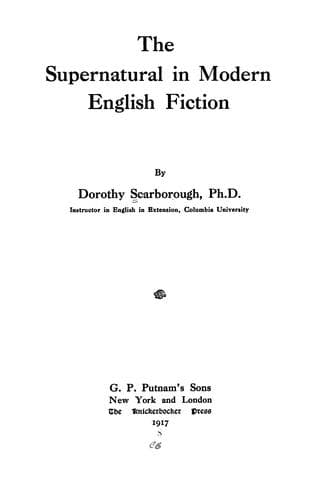
The Supernatural in Modern English FictionScarborough, Dorothy
History
The Supernatural in Modern English Fiction
Scarborough, Dorothy
English fiction -- History and criticism; Supernatural in literature
Sutton, shows the spirits of Russian peasants slain for refusing to
fight, specters unaware that they are dead. Various martial heroes
of the past are resurrected to give inspiration in battle in recent
stories.
[210] _The Eighty-Third._
[211] _Swept and Garnished._
[212] _The Dead Are Singing_, in the May, 1916, _Texas Review_.
But whatever be the reason for this revival of the ghostly, the
fact remains that this is distinctly the day for the phantom and
his confrères. While romanticism is always with us, it appears in
different manifestations. A few years ago the swashbuckling hero and
his adventures seemed the most striking survival of the earlier days
of romanticism, but now the weird and the ghostly have regained a
popularity which they never surpassed even in the heyday of Gothic
fiction. The slashing sword has been displaced by the psychographic
pen. The crucial struggles now are occult, rather than adventurous,
as before, and while realism in fiction is immensely popular--never
more so than now--it is likely to have supernaturalism overlaid upon
it, as in De Morgan's work, to give a single example. Recent poetry
manifests the same tendency, and likewise the drama, particularly the
closet drama and the playlet. While literary history shows clearly the
continuity of the supernatural, with certain rise and fall of interest
in it at different periods, it is apparent that now there is a more
general fondness for the form than at any other period in English
literature. The supernatural is in solution and exists everywhere.
Recent poetry shows a strong predilection for the uncanny, sometimes
in the manner of the old ballads, while in other instances the
ghostly is treated with a spirit of critical detachment as in Rupert
Brooke's sonnet,[213] or with skepticism as in his sardonic satire on
faith.[214] In the recent volume of Brooke's collected poems, there
are about a dozen dealing with the supernatural. Maeterlinck expressed
the feeling that a spiritual epoch is perhaps upon us, as Poe said
that we are in the midst of great psychal powers. As Francis Thompson
says in his _Hound of Heaven_, "Nature, poor step-dame, cannot slake
our drought!" The interest in certain lines of thought which lead to
the writing of supernatural fiction, as Spiritualism or folk-lore, or
science or psychical research, may have the reflex action of arousing
interest in the subjects themselves. But at all events, there is no
lack of uncanny literature at present.
[213] _Suggested by some of the Proceedings of the Society for
Psychical Research._
[214] In his _Heaven_.
Public-domain text, read in full here on John Shaqi.
Reviews
Reviews
No reviews yet
Be the first to share your thoughts on this work.
Elsewhere in the archive
Join the Discussion
Join the discussion
Sign in to leave a comment or review.
Sign InorCreate an account