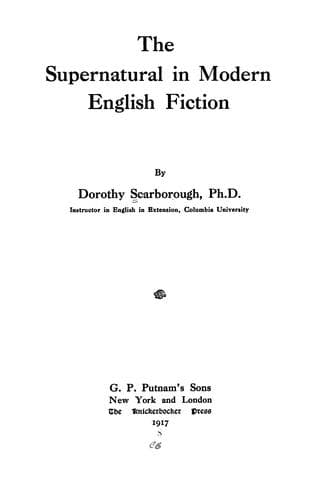
The Supernatural in Modern English FictionScarborough, Dorothy
History
The Supernatural in Modern English Fiction
Scarborough, Dorothy
English fiction -- History and criticism; Supernatural in literature
One feature of the modern supernatural literature as distinguished
from that of other periods, is in the matter of length. Of course,
the ballad and the folk-tale expressed the ghostly in brief form,
but the epic held the stage longer, while in Elizabethan times the
drama was the preferred form as in the eighteenth century the Gothic
novel. During the nineteenth century, particularly the latter half,
the preference was decidedly for the short story, while more recently
the one-act play has come into vogue. But in the last few years the
supernatural novel seems to be returning to favor, though without
displacing the shorter forms. Brevity has much to commend it as a
vehicle for the uncanny. The effect of the ghostly may be attained with
much more unity in a short story or playlet than in a novel or long
drama, for in the more lengthy form much outside matter is necessarily
included. The whole plot could scarcely be made up of the unearthly,
for that would mean a weakening of power through exaggeration, though
this is sometimes found to be the case, as in several of Bram Stoker's
novels. Recently the number of novels dealing with supernatural themes
has noticeably increased, which leads one to believe that the occult
is transcending even the limitations of length and claiming all forms
for its own. Now no literary type bars the supernatural, which appears
in the novel as in the story, in the drama as in the playlet, and in
narrative, dramatic, and lyric poetry. Even the epic of the more than
mortal has not entirely vanished, as the work of Dr. William Cleaver
Wilkinson attests, but popular taste does not really run to epics
nowadays. The ghostly is more often seen in the shorter forms, where
brevity gives a chance for compression and intensity of force difficult
in longer vehicles. The rise of the one-act play in popular favor is
significant in this connection. The short dramas of Synge, Yeats, Lady
Gregory, William Sharpe, Gordon Bottomley, and Theodore Dreiser show
the possibilities of the playlet for weird effect. Maeterlinck's plays
for marionettes are especially powerful, but the work of Lord Dunsany
furnishes more peculiar ghostliness than that of any other present
dramatist. His jade idols, for instance, that wake to terrible life
and revenge themselves on presumptuous mortals, are a new touch in
dramatics. Algernon Blackwood is doing more significant work in psychic
fiction than anyone else, his prose showing poetic beauty as well as
eerie power.
Public-domain text, read in full here on John Shaqi.
Reviews
Reviews
No reviews yet
Be the first to share your thoughts on this work.
Elsewhere in the archive
Join the Discussion
Join the discussion
Sign in to leave a comment or review.
Sign InorCreate an account