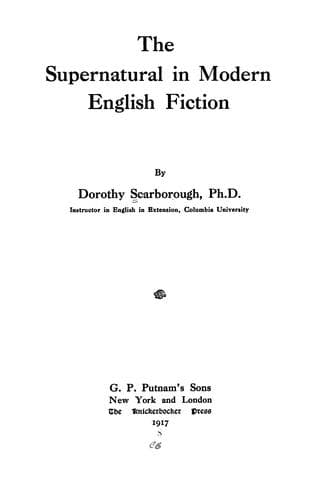
The Supernatural in Modern English FictionScarborough, Dorothy
History
The Supernatural in Modern English Fiction
Scarborough, Dorothy
English fiction -- History and criticism; Supernatural in literature
The demons as well have felt the same leveling influence experienced by
the ghosts and the angels. Only, in their case, the thing is reversed,
and they are raised to the grade of humanity. We are coming to see,
in modern fiction, at least, that the devil is not really black,
only a pleasant mottled gray like ourselves. Satan, in Mark Twain's
posthumous novel,[225] is an affable young fellow, claiming to be the
nephew and namesake of the personage best known by that name. Bernard
Shaw's devil is of a Chesterfieldian courtesy, willing to speed the
parting as to welcome the coming guest. I have found no comic use of
the werewolf or of the vampire, though there are several comic witch
stories, yet all these personages are humanized in modern fiction.
We feel in some recent supernatural stories a sense of a continuing
current of life. These ghosts, devils, witches, angels, and so forth
are too real to be cut short by an author's _Finis_.
[225] _The Mysterious Stranger._
Another aspect of the leveling influence is seen in the more than
natural power of motion, feeling, and intelligence given to inanimate
objects, machinery, plants, and animals, in late literature. The idea
of endowing inanimate figures with life and personality is seen several
times in Hawthorne's stories, as his snow image, Drowne's wooden image,
the vivified scarecrow, Feathertop, that the witch makes. The clay
figures that Satan in Mark Twain's novel models, endues with life, then
destroys with the fine, casual carelessness of a god, remind one of an
incident from mythology. The statue in Edith Wharton's _The Duchess at
Prayer_ that changes its expression, showing on its marble face through
a century the loathing and horror that the living countenance wore, or
Lord Dunsany's jade idol[226] that comes with stony steps across the
desolate moor to exact vengeance on four men helpless in its presence,
has a more intense thrill than Otranto's peripatetic statue. Lord
Dunsany's _The Gods of the Mountains_, of which Frank Harris says, "It
is the only play which has meant anything to me in twenty years," shows
an inexorable fatality as in the Greek drama.
[226] In _A Night at an Inn_.
Science is revealing wonderful facts and fiction is quick to realize
the possibilities for startling situations in every field. So diabolic
botanical specimens, animals endowed with human or more than human
craft--sometimes gifted with immortality as well--add a new interest
to uncanny fiction. And the new machines that make all impossibilities
come to pass inspire a significant class of supernatural stories. In
general, a new force is given to all things, to raise them to the level
of the human.
Public-domain text, read in full here on John Shaqi.
Reviews
Reviews
No reviews yet
Be the first to share your thoughts on this work.
Elsewhere in the archive
Join the Discussion
Join the discussion
Sign in to leave a comment or review.
Sign InorCreate an account