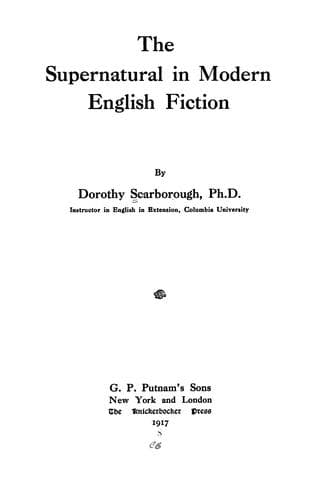
The Supernatural in Modern English FictionScarborough, Dorothy
History
The Supernatural in Modern English Fiction
Scarborough, Dorothy
English fiction -- History and criticism; Supernatural in literature
While it is true that certain writers show a tendency to create
supernatural characters having an excess of evil power beyond the
previous uncanny beings, on the other hand there is an equally strong
and significant tendency to reduce the ghostly beings nearer to the
human. Fiction here, as frequently, seems ahead of general belief, and
refuses to believe in the altogether evil. Ghosts, angels, witches,
devils, werewolves, and so forth are now made more human, more like to
man, yet without losing any of their ancient power to thrill. Ghosts
in late literature have more of the mortal characteristics than ever
before, as has been pointed out in a previous chapter. They look more
human, more normal, they are clad in everyday garments of varied
colors, from red shirts and khaki riding-habits to ball-gowns,--though
gray seems the favored shade for shades as well as witches,--and they
have lost that look of pallor that distinguished early phantoms. Now
they are more than merely vaporous projections as they used to be, more
than merely phantasmogenetic apparitions,--but are healthy, red-blooded
spooks. They are not tongue-tied as their ancestors were, but are very
chatty, giving forth views on everything they are interested in, from
socialism to the present war. And their range of interests has widened
immeasurably. It would seem that the literacy test has been applied to
ghosts in recent fiction. Modern specters are so normal in appearance
that often no one recognizes them as ghosts,--as in Edith Wharton's
story _Afterwards_, where the peculiar thing about the apparition
haunting a certain house is that it is not till long afterwards that
one knows it was a ghost. The man in the gray suit whom the wife thinks
a chance caller is the spirit of a man not yet dead, a terrible living
revenge-ghost, who finally takes his victim mysteriously away with him.
Modern ghosts have both motions and emotions like men, hence mortals
are coming to regard them more sympathetically, to have more of a
fellow-feeling for them.
Likewise the angels are now only a very little higher if any than men.
Seraphs are democratic, and angels have developed a sense of humor
that renders them more interesting than they used to be. The winged
being that H. G. Wells's vicar goes gunning for is a charming youth
with a naïve satire, as the angels in Mark Twain's story of heaven
are realistically mortal and masculine in tastes. They care little
for harps and crowns, grow fidgety under excess of rest, and engage
in all sorts of activities, retaining their individual tastes. James
Stephens's archangel, seraph, and cherub are chatty, cordial souls with
an avidity for cold potatoes and Irish companionship.
Public-domain text, read in full here on John Shaqi.
Reviews
Reviews
No reviews yet
Be the first to share your thoughts on this work.
Elsewhere in the archive
Join the Discussion
Join the discussion
Sign in to leave a comment or review.
Sign InorCreate an account