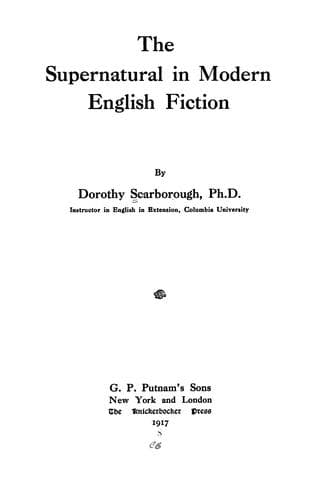
The Supernatural in Modern English FictionScarborough, Dorothy
History
The Supernatural in Modern English Fiction
Scarborough, Dorothy
English fiction -- History and criticism; Supernatural in literature
The search for the philosopher's stone appears in various novels of
the period. _St. Leon_, by William Godwin, relates the story of a man
who knew how to produce unlimited gold by a secret formula given him
by a mysterious stranger who dies in his home. Shelley[25] brings
in this power incidentally with the gift of endless life. There is
an awe-inspiring use of ventriloquism in Charles Brockden Brown's
novel, _Wieland_, while _Arthur Mervyn_ gives a study in somnambulism.
_Zofloya_ suggests hypnotism or mesmerism by saying that Victoria's
thought summoned the Moor to her,--that they could have brought him
had he been "at the further extremity of this terrestrial globe." This
seems a faint foreshadowing of Ibsen's idea in The _Master Builder_.
These may illustrate the use of science in Gothicism.
[25] In _St. Irvyne_.
The elixir of life is brewed in divers Gothic novels. Dramatic and
intense as are the psychological experiences connected with the
discovery of the magic potion, the effects of the success are more
poignant still. The thought that endless mortality, life that may not
be laid down, becomes a burden intolerable has appeared in fiction
since Swift's account of the Struldbrugs, and perhaps before. Godwin's
_St. Leon_ is a story of the secret of perpetual life. The tiresome
Godwinistic hero is visited by a decrepit old man who wishes to tell
him on a pledge of incommunicability what will give him the power of
endless life and boundless wealth. The impoverished nobleman accepts
with consequences less enjoyable than he has anticipated.
Shelley's hectic romance,[26] whose idea, as Shelley admitted to
Stockdale, came from Godwin's book, uses the same theme. The young
student with burning eyes, who has discovered the elixir of life, may
be compared with Mary Shelley's later picture of Frankenstein. Events
are rather confused here, as the villain falls dead in the presence of
the devil but comes to life again as another character later in the
story,--Shelley informing us of their identity but not troubling to
explain it.
[26] _St. Irvyne or the Rosicrucian._
The most impressive instance of the theme of fleshly immortality in
the early novels is found in _Melmoth_. Here the mysterious wanderer
possesses the power of endless life, but not the right to lay it down
when existence becomes a burden. Melmoth can win the boon of death
only if he can find another mortal willing to change destinies with
him at the price of his soul. He traverses the world in his search and
offers the exchange to persons in direst need and suffering the extreme
torments, offering to give them wealth as well as life eternal. Yet no
man nor woman will buy life at the price of the soul.
Public-domain text, read in full here on John Shaqi.
Reviews
Reviews
No reviews yet
Be the first to share your thoughts on this work.
Join the Discussion
Join the discussion
Sign in to leave a comment or review.
Sign InorCreate an account