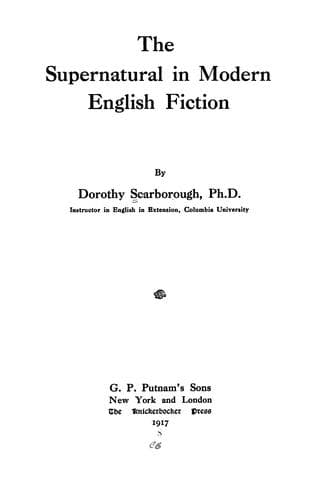
The Supernatural in Modern English FictionScarborough, Dorothy
History
The Supernatural in Modern English Fiction
Scarborough, Dorothy
English fiction -- History and criticism; Supernatural in literature
Hawthorne and Tieck do show certain similarities, as in the use of
the dream element, the employment of the allegory as a medium for
teaching moral truths, and the choice of the legend as a literary
form. Both use somewhat the same dreamy supernaturalism, yet in style
as in subject-matter Hawthorne is much the superior and improved
whatever he may have borrowed from Tieck. Hawthorne's vague mystery,
cloudy symbolism, and deep spiritualism are individual in their effect
and give to his supernaturalism an unearthly charm scarcely found
elsewhere. Hawthorne's theme in _The Marble Faun_, of the attaining to
a soul by human suffering, is akin to the idea in Fouqué's _Undine_.
There the supernaturalism is franker, while that of Hawthorne's novel
is more evasive and delicate, yet the same suggestion is present in
each case. Lowell in his _Fable for Critics_ speaks of Hawthorne as "a
John Bunyan Fouqué, a Puritan Tieck."
There are still more striking similarities to be pointed out between
the work of Poe and that of E. T. A. Hoffmann. As Hawthorne was, to a
slight extent, at least, affected by German legends and wonder tales,
Poe was influenced by Hoffmann's horror stories. Poe has been called
a Germanic dreamer, and various German and English critics mention
the debt that he owes to Hoffmann. Mr. Palmer Cobb[38] brings out some
interesting facts in connection with the two romanticists. He says:
The verification of Poe's indebtedness to German is to be sought in
the similarity of the treatment of the same motives in the work of
both authors. The most convincing evidence is furnished by the way
in which Poe has combined the themes of mesmerism, metempsychosis,
dual existence, the dream element, and so forth, in exact agreement
with the grouping employed by Hoffmann. Notable examples of this
are the employment of the idea of double existence in conjunction
with the struggle of good and evil forces in the soul of the
individual, and the combination of mesmerism and metempsychosis as
leading motives in one and the same story.
[38] _The Influence of E. T. A. Hoffmann on Edgar Allan Poe._
Public-domain text, read in full here on John Shaqi.
Reviews
Reviews
No reviews yet
Be the first to share your thoughts on this work.
Join the Discussion
Join the discussion
Sign in to leave a comment or review.
Sign InorCreate an account