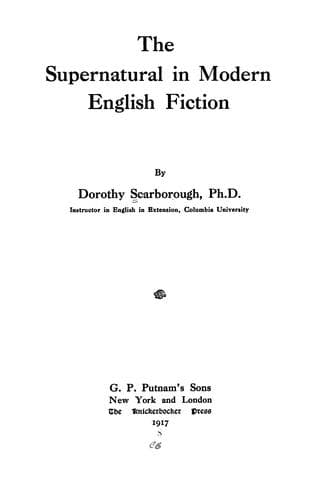
The Supernatural in Modern English FictionScarborough, Dorothy
History
The Supernatural in Modern English Fiction
Scarborough, Dorothy
English fiction -- History and criticism; Supernatural in literature
The ghost is the most enduring figure in supernatural fiction. He
is absolutely indestructible. He glides from the freshly-cut pages
of magazines and books bearing the date of the year of our Lord
nineteen hundred and seventeen as from the parchment rolls of ancient
manuscripts. He appears as unapologetically at home in twentieth
century fiction as in classical mythology, Christian hagiology,
medieval legend, or Gothic romance. He changes with the styles in
fiction but he never goes out of fashion. He is the really permanent
citizen of this earth, for mortals, at best, are but transients. Even
the athlete and the Methusaleh must in the end give up the flesh,
but the wraith goes on forever. In form, too, he wears well. Ghostly
substance of materialization, ethereal and vaporous as it appears
to be, is yet of an astonishing toughness. It seems to possess an
obstinate vitality akin to that attributed to the boll weevil in a
negro ballad, that went on undaunted by heat or cold, rain or drought,
time or tide. The ghost, like death, has all seasons for its own and
there is no closed season for spooks. It is much the case now as ever
that all the world loves a ghost, yet we like to take our ghosts
vicariously, preferably in fiction. We'd rather see than be one.
One point of difference between the ghostly fiction of the past and
of the present is in the matter of length. The Gothic novel was
often a three- or four-decker affair in whose perusal the reader aged
perceptibly before the ghost succeeded or was foiled in his haunting
designs. There was obviously much more leisure on the part of spooks as
well as mortals then than now. Consequently the ghost story of to-day
is told in short-story form for the most part. Poe knew better than
anybody before him what was necessary for the proper economy of thrills
when he gave his dictum concerning the desirable length for a story,
which rule applies more to the ghostly tale than to any other type, for
surely there is needed the unity of impression, the definiteness of
effect which only continuity in reading gives. The ghostly narrative
that is too long loses in impressiveness, whether it is altogether
supernatural or mixed with other elements. In either case, it is less
successful than the shorter, more poignant treatment possible in the
compressed form. The tabloid ghost can communicate more thrills than
the one in diluted narration.
The apparitions in later English fiction fall naturally into several
distinct classes with reference to the reality of their appearance.
There are the mistaken apparitions, there are the purely subjective
specters, evoked by the psychic state of the percipients, and there are
the objective ghosts, independent of the mental state of the witnesses,
appearing to persons who are not mentally prepared to see them.
Public-domain text, read in full here on John Shaqi.
Reviews
Reviews
No reviews yet
Be the first to share your thoughts on this work.
Elsewhere in the archive
Join the Discussion
Join the discussion
Sign in to leave a comment or review.
Sign InorCreate an account