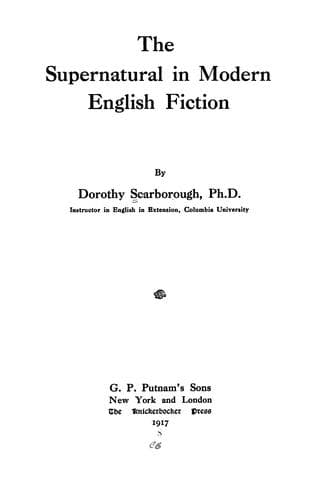
The Supernatural in Modern English FictionScarborough, Dorothy
History
The Supernatural in Modern English Fiction
Scarborough, Dorothy
English fiction -- History and criticism; Supernatural in literature
The subjective ghosts are legion in modern fiction. They are those
evoked by the mental state of the percipients so that they become
realities to those beholding them. The mind rendered morbid by grief
or remorse is readily prepared to see the spirits of the dead return
in love or with reproach. The apparitions in animistic beliefs, as in
classical stories and Gothic romance, were usually subjective, born
of brooding love or remorse or fear of retribution, appearing to the
persons who had cause to expect them and coming usually at night when
the beholders would be alone and given over to melancholy thought or
else to troubled sleep. Shakespeare's ghosts were in large measure
subjective, "selective apparitions." When Brutus asked the specter what
he was, the awful answer came, "Thy evil genius, Brutus!" Macbeth saw
the witches who embodied for him his own secret ambitions, and he alone
saw the ghost of Banquo, because he had the weight of murder on his
heart.
The subjective ghost story is difficult to write, as the effect must
be subtly managed yet inescapably impressive. If done well it is
admirable, and there are some writers who, to use Henry James's words
concerning his own work, are "more interested in situations obscure and
subject to interpretation than the gross rattle of the foreground." The
reader, as well as the writer, must put himself in the mental attitude
of acceptance of the supernatural else the effect is lacking, for the
ghostly thrill is incommunicable to those beyond the pale of at least
temporary credulity.
Public-domain text, read in full here on John Shaqi.
Reviews
Reviews
No reviews yet
Be the first to share your thoughts on this work.
Elsewhere in the archive
Join the Discussion
Join the discussion
Sign in to leave a comment or review.
Sign InorCreate an account