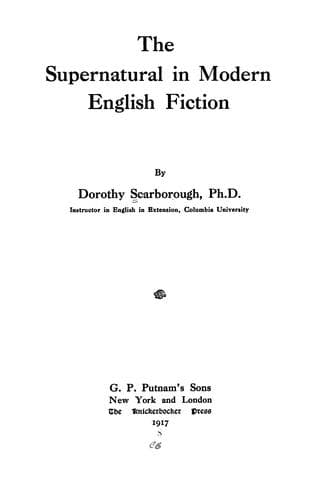
The Supernatural in Modern English FictionScarborough, Dorothy
History
The Supernatural in Modern English Fiction
Scarborough, Dorothy
English fiction -- History and criticism; Supernatural in literature
In Bulwer-Lytton's _The Haunters and the Haunted_ a woman's hand
without a body rises up to clutch the ancient letters, then withdraws,
while in his _Strange Story_ the supernatural manifestation comes as
a vast Eye seen in the distance, moving nearer and nearer, "seeming
to move from the ground at a height of some lofty giant." Then other
Eyes appear. "Those Eyes! Those terrible Eyes! Legions on legions! And
that tramp of numberless feet! _they_ are not seen, but the hollows of
the earth echo to their tread!" The supernatural phenomena in Ambrose
Bierce's stories have an individual horror. In _A Vine on the House_ he
shows a hideous revenge ghost manifested in a peculiar form. A couple
of men take refuge in a deserted house and note a strange vine covering
the porch that shakes unaccountably and violently. In mystification
they dig it up, to find the roots in the form of a woman's body,
lacking one foot, as had been the case with the woman who had lived
there and whose husband had killed her secretly and buried her beside
the porch.
The revenge ghost in modern fiction frequently manifests itself in this
form, mutilated or dismembered, each disfigurement of the mortal body
showing itself in a relentless immortality and adding to the horror
of the haunting. There seems to be no seat of ghostly mind or soul,
for the body can perform its function of haunting in whole or in part,
unaided by the head or heart, like a section of a snake that has life
apart from the main body. And this idea of detached part of the form
acting as a determined agent for revenge adds a new horror to fiction.
I haven't as yet found an instance of a woman's heart, bleeding and
broken, coming up all by itself to haunt the deserting lover, but
perhaps such stories will be written soon. And think what terrors would
await the careless physician or surgeon if each outraged organ or
dismembered limb came back to seek vengeance on him!
Ghosts of modern fiction are more convincing in their reality than the
specters of early times. They are stronger, more vital; there seems
to be a strengthening of ghostly tissue, a stiffening of supernatural
muscle in these days. Ghosts are more healthy, more active, more alive
than they used to be. There is now as before a strong resemblance to
the personality before death, the same immortality of looks that is
discouraging to the prospects of homely persons who have hoped to
be more handsome in a future state. Fiction gives no basis for such
hope. Peculiarities of appearance are carried over with distressing
faithfulness to detail, each freckle, each wrinkle, each gray
hair showing with the clearness of a photographic proof. Note the
lifelikeness of the governess's description of Peter Quint in _The Turn
of the Screw_.
Public-domain text, read in full here on John Shaqi.
Reviews
Reviews
No reviews yet
Be the first to share your thoughts on this work.
Elsewhere in the archive
Join the Discussion
Join the discussion
Sign in to leave a comment or review.
Sign InorCreate an account