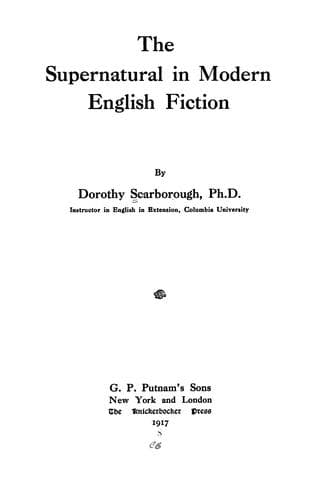
The Supernatural in Modern English FictionScarborough, Dorothy
History
The Supernatural in Modern English Fiction
Scarborough, Dorothy
English fiction -- History and criticism; Supernatural in literature
The ghosts that are actively vicious are the most vivid and numerous
in later fiction. The spirits of evil seem to have a terrible
cumulative force, being far more maleficent than the earlier ones,
and more powerful in carrying out their purposes. Every aspect of
supernaturalism seems to be keyed up to a higher pitch of terror. Evil
seems to have a strangely greater power of immortality over that of
good, judging from the proportion employed in modern fiction. Has evil
so much more strength of will, so much more permanence of power that
it lives on through the years and centuries, while good deeds perish
with the body? It would appear so from fiction. The ghosts of good
actions do not linger round the abode of the living to any noticeable
extent, but evil deeds are deathless. We have many stories of places
and persons haunted by the embodied evil of the past, but few by the
embodied good. The revenge ghosts outnumber the grateful dead by
legions.
Modern specters have a more complex power than the old. They are more
awful in their import, for they haunt not merely the body, but the
soul. The wicked spirits will to work dreadful harm to the soul as
well as the body, and drive the victim to spiritual insanity, seeking
to damn him for the life everlasting, making him, not merely their
victim, but through eternity their co-worker in awful evil. The victim
of the vampire, for instance, who dies as a result of the attack, has
to become in his turn a loathsome vampire to prey on other souls and
bodies. Blackwood's Devil-worshipers seek to kill the soul as well
as the body of their victim. The deathlessness of evil is shown in
Lytton's[123] and in many of Blackwood's stories, as where the psychic
doctor says to a man, "You are now in touch with certain violent
emotions, passions, purposes, still active in this house, that were
produced in the past by some powerful and evil personality that lived
here."
[123] _The Haunters and the Haunted._
Few writers have equaled F. Marion Crawford in the modern ghost story.
His tales have a curdling intensity, a racking horror that set them far
above the ordinary supernatural fiction. They linger in the mind long
after one has tried in vain to forget them, if indeed one ever does
forget their sense of evil power. There is in each of his stories an
individual horror that marks it as distinct from its fellows, a power
chiefly won by delineation of this immortality of evil, as in _The Dead
Smile_, with its description of the hideous smile that pollutes the
lips of the living and of the dead. "Nurse McDonald said that when Sir
Hugh Ockram smiled, he saw the faces of two women in hell, two dead
women he had betrayed." His vicious impulses last after death and from
his grave he reaches out to curse his own children, seeking to drive
them to awful, though unconscious sin.
Public-domain text, read in full here on John Shaqi.
Reviews
Reviews
No reviews yet
Be the first to share your thoughts on this work.
Elsewhere in the archive
Join the Discussion
Join the discussion
Sign in to leave a comment or review.
Sign InorCreate an account