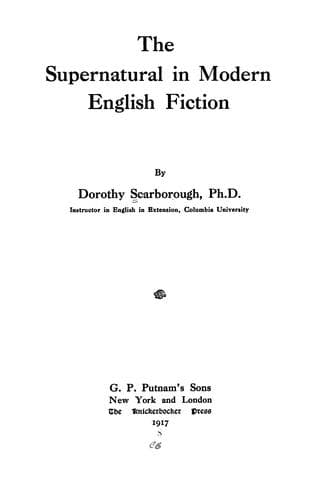
The Supernatural in Modern English FictionScarborough, Dorothy
History
The Supernatural in Modern English Fiction
Scarborough, Dorothy
English fiction -- History and criticism; Supernatural in literature
There are some unhappy spirits in recent fiction, but not such a large
proportion as in the past. And there is usually some basis for their
joylessness; they don't have general melancholia with no grounds for
it. The ghost of the dead wife in _Readjustment_[117] is miserable
because she has never understood her husband, either in life or in
death, and she comes back seeking an explanation. Another spectral
woman[118] is wretched because she has the double crime of murder and
suicide on her soul. Poor Marley grieves because he is doomed to see
the opportunities that life has offered him to serve others and that he
has neglected, being forced to see with the clear vision of the other
world the evil results of his own neglect, which is enough to make any
one wretched. A guilty conscience is like the burning heart that each
spirit in the Hall of Eblis bore in his breast. In _The Roll-call of
the Reef_,[119] the troop of drowned soldiers, infantry, and horsemen,
come rising out of the surf to answer to their names. Each man is asked
by name, "How is it with you?" and answers with the deadly sin that
has damned him. In Wilkie Collins's gruesome tale[120] there is one
spirit that is unhappy because his body lies unburied, a recurrence of
a theme frequent in classical stories and Gothic romance, but rare in
later fiction. For the most part the later ghosts are something more
than merely unhappy spirits. They are more positive, more active, more
individualistic, too philosophical to waste time in useless grieving.
[117] By M. H. Austin.
[118] In _The Closed Cabinet_.
[119] By A. T. Quiller-Couch.
[120] _The Queen of Hearts._
Nor are there many simply happy spirits, perhaps because the joyous
souls are likely to seek their paradise and forget about the earth. Yet
there are instances, such as the light-hearted spirits of children in
various stories, that with the resilience of childhood shake off gloom
and are gay; Rosamond,[121] that comes back to tell her friend how
happy the other life is, the peacefully content mother,[122] and others.
[121] In _Here and There_.
[122] In _They That Mourn_.
Public-domain text, read in full here on John Shaqi.
Reviews
Reviews
No reviews yet
Be the first to share your thoughts on this work.
Elsewhere in the archive
Join the Discussion
Join the discussion
Sign in to leave a comment or review.
Sign InorCreate an account