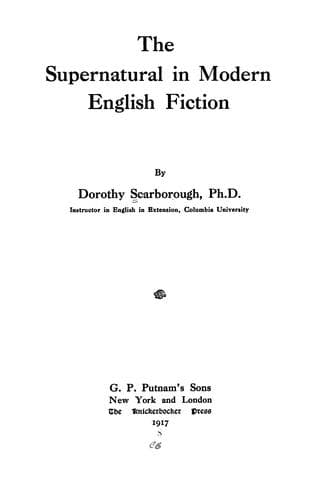
The Supernatural in Modern English FictionScarborough, Dorothy
History
The Supernatural in Modern English Fiction
Scarborough, Dorothy
English fiction -- History and criticism; Supernatural in literature
One curious incident in the story is the instantaneous
appearance on the stairs of the woman herself and her ghostly double,
one in a white dress, one in the fatal blue. This sort of spectral
warning, this wireless service for the conveyance of bad news and hint
of threatening danger, serves to link the ghost story of the present
with those of the past. The records of the Psychical Society show
hundreds of such instances, and much use is made in fiction of plots
hinging on such motif. Scott's White Lady of Avenel appears as a death
portent, as also the "Bahr-geist" in another novel.
[127] In _The Substitute_.
[128] In _A Haunted Island_.
The revenge ghost looms large in fiction as in the drama. He was
the most important figure in Elizabethan as in classical drama, and
Shakespeare's ghosts are principally of that class. A terrible example
of the type is in Robert Lovell Beddoes' _Death's Jest-Book_, that
extraordinary example of dramatic supernaturalism, where the ghost of
the murdered man comes back embodied from the grave and is an active
character to the end of the play. He is summoned to life through a
hideous mistake, the murderer having asked the magician to call up
the spirit of his dead wife, but the body of his victim having been
secretly buried beside her so that the murderer may have no rest
even in the grave, the awful accusing spirit rises to confront him,
instead of his wife's phantom. The revenge ghost is both objective
and subjective in his manifestation and his impelling motive adds a
touch of frozen horror to his appearance. He appears in various forms,
as dismembered parts of the body--illustrated in the stories above
referred to,--in a horrific invisibility, in a shape of fear visible
only to the guilty, or in a body so objectified as to seem absolutely
real and living to others beside the one haunted. The apparently
casual, idle figure that strolls about the docks and streets in _The
Detective_, seen by different persons and taken for a man interested
only in his own pursuits, is a revenge ghost so relentless that he
hounds his victim from country to country, at last killing him by sheer
force of terror as he sits on his bed at night, leaving the imprint
of his body on the mattress beside the dead man whose face is rigid
with mad horror. He has come back in physical embodiment to avenge
the betrayal of his daughter. Ambrose Bierce shows us many spirits
animated by cold and awful revenge, sometimes visible and sometimes
unseen, as where a soldier killed for striking an officer answers,
"Here!" to the roll-call, just at which moment a mysterious bullet from
nowhere strikes the officer through the heart.[129] Crawford sends
a drowned sailor back in wet oil-skins to slay his twin brother who
has impersonated him to win the girl they both loved. When the two
bodies wash ashore one is a newly dead corpse, the other a skeleton
in oil skins; while the dreadful rattle of the accusing lump of lead
Public-domain text, read in full here on John Shaqi.
Reviews
Reviews
No reviews yet
Be the first to share your thoughts on this work.
Elsewhere in the archive
Join the Discussion
Join the discussion
Sign in to leave a comment or review.
Sign InorCreate an account