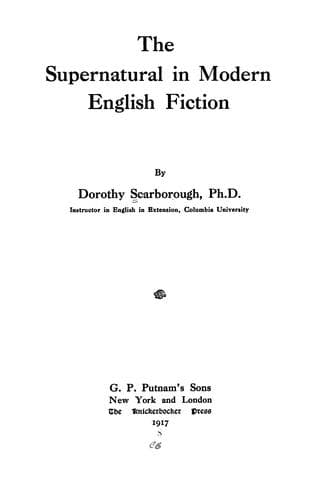
The Supernatural in Modern English FictionScarborough, Dorothy
History
The Supernatural in Modern English Fiction
Scarborough, Dorothy
English fiction -- History and criticism; Supernatural in literature
[140] Other stories of double personality are _The Ivory Gate_,
by Walter Besant; _The Man with a Shadow_, by George M. Fenn;
_The Jolly Corner_, by Henry James; _The Transferred Ghost_,
by Frank R. Stockton; _On the Stairs_, by Katherine Fullerton
Gerould; _Elixiere des Teufels_, by E. T. A. Hoffmann; _Howe's
Masquerade_, by Hawthorne; _The Recent Carnival of Crime in
Connecticut_, by Mark Twain; _The Queen of Sheba_, by Thomas
Bailey Aldrich; _The Doppelgänger_, by Elizabeth Bisland
Wetmore.
Georg Brandes, in his article, "Romantic Reduplication
and Psychology," in _Main Currents of Nineteenth Century
Literature_, points out the prevalence of this motif in German
fiction. He says: "It finds its first expression in Jean
Paul's _Leibgeber Schappe_, and is to be found in almost all
of Hoffmann's tales, reaching its climax in _Die Elixiere des
Teufels_. It crops up in the writings of all the Romanticists,
in Kleist's _Amphitryon_, in Achim von Arnim's _Die Beiden
Waldemar_, in Chamisso's _Erscheinung_. Brentano treats it
comically in _Die Mehreren Wehmüller_."
Distinct from the expression of one personality in two bodies, the
supernatural merging of two separate personalities into one appears
in recent ghostly fiction. It forms a subtle psychologic study and is
uncannily effective. H. G. Wells's _Story of the Late Mr. Elvesham_
is a peculiar narrative of a transfer of personality as the result of
a mysterious drink, by which an old man takes possession of a young
man's body, leaving the youth to inhabit the worn-out shell of the
dotard. Algernon Blackwood in _The Terror of the Twins_ describes a
supernatural merging of two natures into one by the power of a dead
father's insane curse. The younger son loses his vitality, his mind,
his personality, all of which is supermortally given to his older
brother, while the deprived son dies a drivelling idiot of sheer
inertia and utter absence of vital power. Mary Heaton Vorse[141]
describes a neurotic woman who comes back from the grave to obsess and
possess the interloper in her home, through the immortal force of her
jealousy, making the living woman actually become the reincarnation
of the dead wife. This story naturally suggests Poe's _Ligeia_ which
is the climax of ghostly horror of this motif, with its thesis that
"man doth not yield himself to the angels nor unto death utterly save
through the weakness of his own feeble will" expressed in a terrible
crescendo of ghastly horror. Poe's _Morella_ is a similar study of the
supernatural merging of an exterior personality into a living body,
where the dead mother and her child are literally one flesh and one
spirit. Blackwood's _The Return_ is an example of the compact-ghost,
that comes back at the hour of death to reveal himself to his friend
as he long ago promised he would. The dead artist manifests himself
Public-domain text, read in full here on John Shaqi.
Reviews
Reviews
No reviews yet
Be the first to share your thoughts on this work.
Elsewhere in the archive
Join the Discussion
Join the discussion
Sign in to leave a comment or review.
Sign InorCreate an account