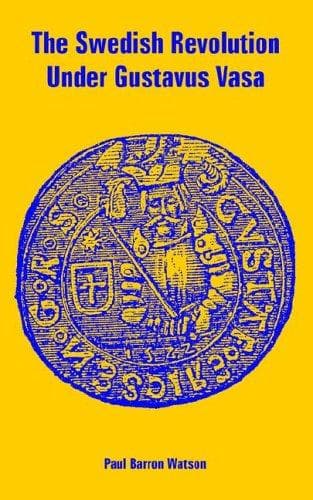
The Swedish Revolution Under Gustavus VasaWatson, Paul Barron
History
The Swedish Revolution Under Gustavus Vasa
Watson, Paul Barron
Gustav I Vasa, King of Sweden, 1496-1560; Sweden -- History -- Gustav I Vasa, 1523-1560
raised his voice against it, and the weight of his influence was such
that finally the whole project was given up. The Lutherans, however,
were not disheartened. Finding that nothing could be effected through
the Church, they proceeded to make a translation of their own. This was
published, though without the translators' names, in 1526. It did not,
of course, receive the sanction of the archbishop, but it paved the way
for new reforms by checking the Roman Catholics in their scholastic
doctrine and by educating the common people in the Word of God.[135]
Brask was now openly beneath the monarch's frown. The rupture between
them was becoming every day more wide, and both parties gradually grew
conscious it could not be healed. Brask had never forgiven the king for
sanctioning the marriage of Olaus Petri. Some six months after the event
he alluded to it in a letter to Peder Galle. "I am much troubled," he
declared, "that marriage is permitted to the clergy, and that no one
cries out against it. I have urged the king that Petri be excommunicated
for his act, that evil example may not spread, but have had only a
half-hearted answer from his Majesty." While this wrong still rankled in
the prelate's breast, his ire was further kindled by the monarch's
evident intention to rob the Church of several of her chief estates. As
an entering wedge Gustavus had pastured his soldiers' horses on the rich
but fallow lands belonging to the monasteries, and in some cases the
officers had been billeted in the monasteries themselves. Against this
practice Brask protested, and received this soothing answer: "When you
say that this mode of billeting cripples the service of God, you are
right, provided his service consists in feeding a body of hypocrites
sunk, many of them, in licentiousness, rather than in providing
protection for the common people. As to your assertion that the
monasteries were not founded by the crown, and hence are not subject to
our dominion, we will look into the matter, though our humble opinion is
that the monasteries were originally bound to pay taxes to the crown."
The argument which the monarch strove to make was this: Those
monasteries which were founded by individuals comprised estates held by
the donors in consideration of military service to be rendered to the
crown; and so soon as the military service ended, the tenure by which
the lands were held no longer existed, and the crown once more became
entitled to the lands. It is difficult to feel that the monarch's view
was right. In countries where there is no written law, all controversies
must be determined by the law of custom, and it is certain that for
centuries Swedish subjects had been allowed to dedicate for religious
purposes the property which they held by military tenure of the crown.
With Gustavus it appears that custom was of little moment. The
monasteries were wealthy, and could be encroached upon without directly
injuring the people.
Public-domain text, read in full here on John Shaqi.
Reviews
Reviews
No reviews yet
Be the first to share your thoughts on this work.
Elsewhere in the archive
Join the Discussion
Join the discussion
Sign in to leave a comment or review.
Sign InorCreate an account