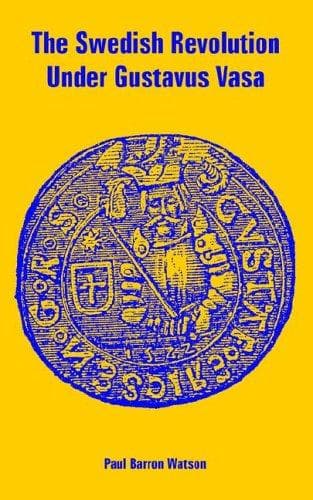
The Swedish Revolution Under Gustavus VasaWatson, Paul Barron
History
The Swedish Revolution Under Gustavus Vasa
Watson, Paul Barron
Gustav I Vasa, King of Sweden, 1496-1560; Sweden -- History -- Gustav I Vasa, 1523-1560
The reign of Hans lasted about four years. At first he appeared desirous
to promote the welfare of Sweden and to conform to the terms of the
Kalmar Recess. But before long even the Cabinet began to grow weary of
their king. The benefits conferred upon them were not so great as they
had hoped. As for Sture, at his renunciation of the regency he had been
granted extensive fiefs both in Sweden and in Finland; but in 1499 the
king forced him to resign a large portion of these fiefs. The other
members of the Cabinet, now having less cause of jealousy, became more
friendly to Sten Sture. His old enemy, Svante Sture, was at length
reconciled to him through the mediation of their common admirer, Dr.
Hemming Gad. Even with the clergy Sten Sture was now on better terms;
and at his solicitation, in January, 1501, the Chapter of Linköping
elected Gad to fill their vacant see. The main ground of complaint
against Hans was that he disregarded the clause of the Recess which
forbade the granting of Swedish fiefs to Danes. Matters reached a crisis
in 1501, when Sten and Svante Sture, Gad, and three others met in
council and took oath to resist the oppression of their foreign ruler.
This step was the signal for a general explosion. On every side the
people rose in arms. Hans was in despair. He first took counsel with his
warm supporter, the archbishop, and then, on the 11th of August, 1501,
set off with his whole fleet for Denmark.
In the royal castle at Stockholm he left his wife Christina, who, with
Erik Trolle and a force of one thousand men, was determined to resist.
Gad, whose election to the bishopric of Linköping the pope refused to
ratify, undertook to besiege the castle. Meantime Svante Sture laid
siege to Örebro, and Sten proceeded to Dalarne and other parts to gather
forces. On the 12th of November the Cabinet again called Sten Sture to
the regency. In February the Castle of Örebro fell. And still Christina
with her brave followers held out. Not till the 9th of May, after a
bloody assault, could the patriots force a passage. Then they found
that, of the one thousand who had formed the original garrison, but
seventy were alive. Christina was conveyed to Vadstena, where she
remained several months pending negotiations. At the close of the year
1503 she was accompanied to the frontier by the regent, who however was
taken ill on his return journey, and died at Jönköping on the 13th of
December, 1503. Sten Sture had done much for Sweden. Though himself a
magnate, and ambitious to increase his power, he was zealous for the
welfare of his country, and did more than any other of his time to awake
Sweden to a sense of her existence as a nation. It was on the foundation
laid by him that a still greater leader was soon to build a mighty
edifice.
Public-domain text, read in full here on John Shaqi.
Reviews
Reviews
No reviews yet
Be the first to share your thoughts on this work.
Join the Discussion
Join the discussion
Sign in to leave a comment or review.
Sign InorCreate an account