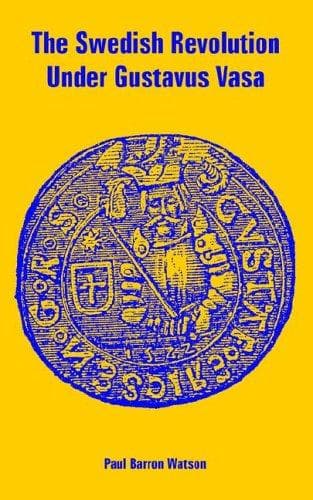
The Swedish Revolution Under Gustavus VasaWatson, Paul Barron
History
The Swedish Revolution Under Gustavus Vasa
Watson, Paul Barron
Gustav I Vasa, King of Sweden, 1496-1560; Sweden -- History -- Gustav I Vasa, 1523-1560
burgomaster and Council of Stockholm act as mediators in the dispute;
and on the 20th of October Ulfsson wrote to Sture to appoint a time for
conference. The regent, however, was not so easily deceived. Trolle was
still adding to his strength in Stäket, and looking forward to aid from
Denmark. The regent therefore replied to Ulfsson that Trolle had brought
on the dispute, and he must answer for it. "As to a conference with
you," adds the regent, "my time is now so fully occupied that I can
appoint no day before the Cabinet meeting to be held shortly at Arboga."
About the same time he wrote to the Chapter at Upsala, insisting on an
answer to a former letter, in which he had called on them to declare
whether they proposed to side with him or the archbishop. In this letter
he informs them: "As to your question whether I intend to obey the
ordinances of the Church, I answer that I shall defend the Holy Church
and respect the persons of the clergy as becomes a Christian nobleman,
provided you will allow me so to do; and I have never purposed
otherwise." Still, however, the Chapter prevaricated, and gave no
answer; till finally the regent sent them his ultimatum, closed, like
all his letters, with the modest signature, "Sten Sture, soldier."[24]
On New Year's day, 1517, the Cabinet met at Arboga, where a general diet
of the kingdom was gathering to discuss the state of affairs concerning
Denmark. At this meeting, as at the one preceding, none of the
archbishop's followers were present. So soon as the Cabinet had
separated, the regent, in compliance with their suggestion, sent envoys
once more to Trolle, urging him to renounce his allegiance to the Danish
king and to surrender Stäket. To this the stubborn archbishop answered
that he would not yield Stäket so long as his heart beat within him. He
then turned his guns upon the regent's envoys, and fired on them as they
withdrew. A few days later the regent learned from one of Trolle's
officers whom he had taken prisoner that the archbishop had received a
letter from King Christiern promising all who gave their aid in
establishing him on the throne a double recompense for any loss incurred
in the attempt. No time was, therefore, to be lost. Collecting a force
with all haste from different parts of Sweden, the regent advanced on
Stäket to besiege the castle. Immediately on their arrival, Trolle sent
out word that he desired a parley. This was granted, and the archbishop
came outside the walls to a spot before the Swedish camp. In the course
of the discussion, Trolle, perhaps with a view to intimidate the regent,
declared that he had within the castle a letter from King Christiern
announcing that he would come to the relief before the 1st of May. But
the young regent was not so easily to be intimidated. His terms were
that Trolle and his men might withdraw unharmed from Stäket, and that
the archbishop might continue in possession of the Cathedral of Upsala
Public-domain text, read in full here on John Shaqi.
Reviews
Reviews
No reviews yet
Be the first to share your thoughts on this work.
Join the Discussion
Join the discussion
Sign in to leave a comment or review.
Sign InorCreate an account