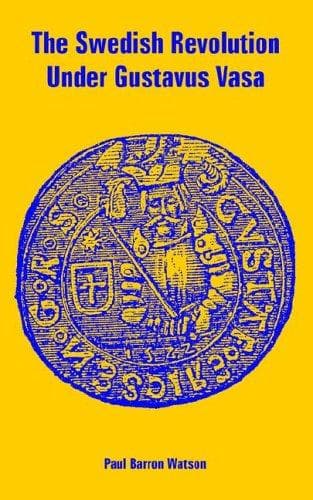
The Swedish Revolution Under Gustavus VasaWatson, Paul Barron
History
The Swedish Revolution Under Gustavus Vasa
Watson, Paul Barron
Gustav I Vasa, King of Sweden, 1496-1560; Sweden -- History -- Gustav I Vasa, 1523-1560
Meantime the Danish arms had not been idle. Soon after the overthrow of
Trolle and the destruction of his castle, the king of Denmark had
despatched a messenger to Rome, to enlist the Holy Father in his cause.
Pope Leo, reluctant to take upon himself to decide a matter of whose
merits he could know so little, appointed the archbishop of Lund, aided
by a Danish bishop, to investigate the question and report to him. A
tribunal so composed could scarcely be expected to render other verdict
than that which Christiern wished. They reported adversely to the
regent. Sture and his adherents were therefore excommunicated by the
pope, and all church ministrations interdicted throughout Sweden. To a
pious people such a blow was terrible in the extreme. All church bells
were for the moment hushed, the church doors barred, and the souls of an
entire nation doomed to eternal death. But even in the face of this
calamity the regent persevered. He refused to restore Trolle to his
post, or even to make him amends for his losses. On this news being
brought to Rome, the pontiff made no attempt to hide his wrath. He wrote
at once to Christiern, with instructions to enter Sweden and inflict
punishment on those who had thus set at naught the papal power.
Christiern was entranced. As champion of the pope he felt certain of
success. Without delay he collected all the forces in the kingdom, horse
and foot, and placed them under the command of a gallant young officer,
Otto Krumpen, with orders to invade Sweden from the south. They landed
in the early days of January, 1520, and proceeded northwards, ravaging
the country as they went. Sture at once issued a broadside to the
people, calling them to arms. He likewise sent his messengers to Trolle,
to beg him to use his influence against the enemies of Sweden. The
deposed archbishop, now cringing before his victor, yielded his assent.
Sture, thus emboldened, moved forward with his army to meet the Danes.
Knowing that they were advancing through the province of Vestergötland,
and that their line of march in the winter season would be across the
lakes, Sture took up his position in a narrow cove at the northern end
of Lake Åsunden. In the centre of this cove, through which the Danes
must pass, he raised a huge bulwark of felled trees, and within the
bulwark stationed his infantry, with provisions enough to last two
months. He then chopped up the ice about the fort, and retired to the
north with his cavalry to await the onset. It was not long he had to
wait. On the 18th of January the Danish army drew near, and seeing the
fortification began to storm it with their catapults. As they
approached, the Swedish cavalry, with Sture at their head, dashed out
along the shore to meet them. The regent was mounted on a fiery charger,
and carried into the very thickest of the fight. But scarcely had the
first shot been fired when a missile glancing along the ice struck
Sture's horse from under him, and in a moment horse and rider were
Public-domain text, read in full here on John Shaqi.
Reviews
Reviews
No reviews yet
Be the first to share your thoughts on this work.
Join the Discussion
Join the discussion
Sign in to leave a comment or review.
Sign InorCreate an account