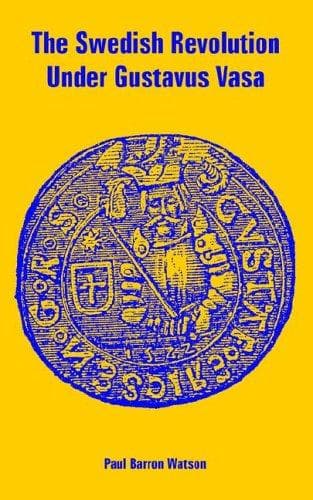
The Swedish Revolution Under Gustavus VasaWatson, Paul Barron
History
The Swedish Revolution Under Gustavus Vasa
Watson, Paul Barron
Gustav I Vasa, King of Sweden, 1496-1560; Sweden -- History -- Gustav I Vasa, 1523-1560
In contemplating this struggle as a whole, the reader will doubtless be
impressed by the extraordinary ease with which the victory was won. In
less than two years and a half after the first blow was struck, the
Danish tyrants had been driven from every stronghold, and the patriots
had placed their leader on the throne. Indeed, eighteen months had
scarcely passed when the issue was practically decided. The remaining
year consisted mainly in the reduction of Sweden's strongholds, and was
marked by little bloodshed. It furnished small opportunity either for
brilliant strategy or for acts of startling courage. The enforced
absence of the Danish monarch prevented his army from entering the
field, and the patriots had neither arms nor ammunition with which to
storm the forts. Both parties, therefore, waited; and the last year was
little more than a test to determine the endurance of the contending
armies. While, however, this period wants many of the features that make
war grand, it is yet instructive if not interesting in its results. The
struggle at the beginning was against overwhelming odds. The patriots
had neither ammunition nor resources, and their leader was without
prestige. On the other hand the Danes were well supplied with men and
arms, and were led by one of the powerful monarchs of Europe backed by
all the authority and influence of Rome. In spite of all this, the
patriots grew in numbers day by day, while the Danish forces steadily
declined. The patriots succeeded in obtaining rich supplies of men and
arms from abroad, while Christiern was scarce able to keep his army from
starvation. One by one the strongholds which he had seized surrendered,
till finally his entire army was forced to yield, and Sweden, from her
place as a weak and down-trodden Danish province, attained an enviable
position among the great monarchies of Europe. The key to this
marvellous transformation in the two parties can be found only in the
characters of their respective leaders. The people were horrified by the
brutal cruelties of Christiern, while allured by the evident sincerity
and enthusiasm of Gustavus. In all history there is no more striking
example of the far-reaching influence which individual characters
sometimes exert upon a nation's growth.
FOOTNOTES:
[56] Svaning, _Christ. II._, pp. 432-433; Svart, _Gust. I.'s krön._, pp.
17-18 and 20-21; Ludvigsson, _Collect._, pp. 86-87; and _Sver. trakt._,
vol. iv. pp. 1-5.
[57] Svart, _Gust. I.'s krön._, pp. 18-19 and 21-23; _Christ. II.'s
arkiv_, vol. iv. pp. 1340-1348; and _Dipl. Dal._, vol. i. pp. 237-238.
[58] Rensel, _Berättelse_, p. 19; Svart, _Gust. I.'s krön._, p. 26;
_Christ. II.'s arkiv_, vol. iv. pp. 1338-1339 and 1353-1356; and _Dipl.
Dal._, vol. i. pp. 240-241.
[59] Svart, _Gust. I.'s krön._, pp. 25-26; and _Christ. II.'s arkiv_,
vol. iv. pp. 1349-1350 and 1352-1353.
[60] Svart, _Gust. I.'s krön._, pp. 24 and 26-30.
[61] Svart, _Gust. I.'s krön._, pp. 31-34.
Public-domain text, read in full here on John Shaqi.
Reviews
Reviews
No reviews yet
Be the first to share your thoughts on this work.
Elsewhere in the archive
Join the Discussion
Join the discussion
Sign in to leave a comment or review.
Sign InorCreate an account