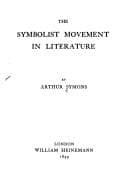
The Symbolist Movement in LiteratureSymons, Arthur
History
The Symbolist Movement in Literature
Symons, Arthur
French literature -- 19th century -- History and criticism; Symbolism (Literary movement) -- France
The fear of death is not cowardice; it is, rather, an intellectual
dissatisfaction with an enigma which has been presented to us, and
which can be solved only when its solution is of no further use. All
we have to ask of death is the meaning of life, and we are waiting
all through life to ask that question. That life should be happy or
unhappy, as those words are used, means so very little; and the
heightening or lessening of the general felicity of the world means
so little to any individual. There is something almost vulgar in
happiness which does not become joy, and joy is an ecstasy which can
rarely be maintained in the soul for more than the moment during which
we recognize that it is not sorrow. Only very young people want to be
happy. What we all want is to be quite sure that there is something
which makes it worth while to go on living, in what seems to us our
best way, at our finest intensity; something beyond the mere fact that
we are satisfying a sort of inner logic (which may be quite faulty)
and that we get our best makeshift for happiness on that so hazardous
assumption.
Well, the doctrine of Mysticism, with which all this symbolical
literature has so much to do, of which it is all so much the
expression, presents us, not with a guide for conduct, not with a plan
for our happiness, not with an explanation of any mystery, but with a
theory of life which makes us familiar with mystery, and which seems to
harmonise those instincts which make for religion, passion, and art,
freeing us at once of a great bondage. The final uncertainty remains,
but we seem to knock less helplessly at closed doors, coming so much
closer to the once terrifying eternity of things about us, as we come
to look upon these things as shadows, through which we have our shadowy
passage. "For in the particular acts of human life," Plotinus tells us,
"it is not the interior soul and the true man, but the exterior shadow
of the man alone, which laments and weeps, performing his part on the
earth as in a more ample and extended scene, in which many shadows
of souls and phantom scenes appear." And as we realise the identity
of a poem, a prayer, or a kiss, in that spiritual universe which we
are weaving for ourselves, each out of a thread of the great fabric;
as we realise the infinite insignificance of action, its immense
distance from the current of life; as we realise the delight of feeling
ourselves carried onward by forces which it is our wisdom to obey; it
is at least with a certain relief that we turn to an ancient doctrine,
so much the more likely to be true because it has so much the air of
a dream. On this theory alone does all life become worth living, all
art worth making, all worship worth offering. And because it might
slay as well as save, because the freedom of its sweet captivity might
so easily become deadly to the fool, because that is the hardest path
to walk in where you are told only, walk well; it is perhaps the only
Public-domain text, read in full here on John Shaqi.
Reviews
Reviews
No reviews yet
Be the first to share your thoughts on this work.
Elsewhere in the archive
Join the Discussion
Join the discussion
Sign in to leave a comment or review.
Sign InorCreate an account