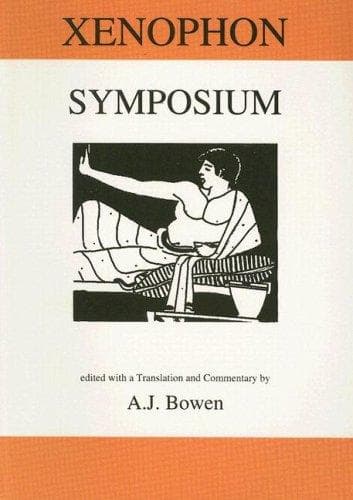
Classical literature; Philosophy, Ancient; Socrates, 470 BC-399 BC
Or again, if it be sweet to win from willing hearts the things we seek
for, I am persuaded that, by the eloquence of silence, I could win a
kiss from yonder girl or boy more speedily than ever you could, O sage!
by help of half a hundred subtle arguments.
Eh, bless my ears, what's that? (Socrates broke in upon this final
flourish of the speaker). So beautiful you claim to rival me, you
boaster?
Crit. Why, yes indeed, I hope so, or else I should be uglier than all
the Silenuses in the Satyric drama. (33)
(33) The MSS. add ("to whom, be it noted, Socrates indeed bore a
marked resemblance"). Obviously a gloss. Cf. Aristoph. "Clouds,"
224; Plat. "Symp." 215 B.
Good! (Socrates rejoined); the moment the programme of discussion is
concluded, (34) please remember, we must obtain a verdict on the point
of beauty. Judgment shall be given--not at the bar of Alexander, son
of Priam--but of these (35) who, as you flatter yourself, have such a
hankering to kiss you.
(34) Lit. "the arguments proposed have gone the round."
(35) i.e. "the boy and girl." Al. "the present company, who are so
eager to bestow on you their kisses."
Oh, Socrates (he answered, deprecatingly), will you not leave it to the
arbitrament of Cleinias?
Then Socrates: Will you never tire of repeating that one name? It is
Cleinias here, there, and everywhere with you.
Crit. And if his name died on my lips, think you my mind would less
recall his memory? Know you not, I bear so clear an image of him in my
soul, that had I the sculptor's or the limner's skill, I might
portray his features as exactly from this image of the mind as from
contemplation of his actual self.
But Socrates broke in: Pray, why then, if you bear about this lively
image, why do you give me so much trouble, dragging me to this and that
place, where you hope to see him?
Crit. For this good reason, Socrates, the sight of him inspires
gladness, whilst his phantom brings not joy so much as it engenders
longing.
At this point Hermogenes protested: I find it most unlike you, Socrates,
to treat thus negligently one so passion-crazed as Critobulus.
Socrates replied: Do you suppose the sad condition of the patient dates
from the moment only of our intimacy?
Herm. Since when, then?
Public-domain text, read in full here on John Shaqi.
Reviews
Reviews
No reviews yet
Be the first to share your thoughts on this work.
Join the Discussion
Join the discussion
Sign in to leave a comment or review.
Sign InorCreate an account