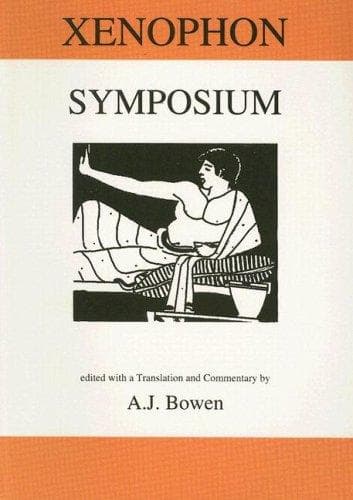
Classical literature; Philosophy, Ancient; Socrates, 470 BC-399 BC
Nay, so help me Heaven! (he replied), but I do love most desperately
yourself, O Socrates!
Whereat Socrates, still carrying on the jest, with a coy, coquettish
air, (14) replied: Yes; only please do not bother me at present. I have
other things to do, you see.
(14) Al. "like a true coquet." Cf. Plat. "Phaedr." 228 C.
Antisthenes replied: How absolutely true to your own character, arch
go-between! (15) It is always either your familiar oracle won't suffer
you, that's your pretext, and so you can't converse with me; or you are
bent upon something or somebody else.
(15) See "Mem." III. xi. 14.
Then Socrates: For Heaven's sake, don't carbonado (16) me, Antisthenes,
that's all. Any other savagery on your part I can stand, and will stand,
as a lover should. However (he added), the less we say about your love
the better, since it is clearly an attachment not to my soul, but to my
lovely person.
(16) Or, "tear and scratch me."
And then, turning to Callias: And that you, Callias, do love Autolycus,
this whole city knows and half the world besides, (17) if I am not
mistaken; and the reason is that you are both sons of famous fathers,
and yourselves illustrious. For my part I have ever admired your nature,
but now much more so, when I see that you are in love with one who does
not wanton in luxury or languish in effeminacy, (18) but who displays to
all his strength, his hardihood, his courage, and sobriety of soul.
To be enamoured of such qualities as these is a proof itself of a true
lover's nature.
(17) Lit. "many a foreign visitor likewise."
(18) See the Attic type of character, as drawn by Pericles, Thuc. ii.
40.
Whether indeed Aphrodite be one or twain (19) in personality, the
heavenly and the earthly, I cannot tell, for Zeus, who is one and
indivisible, bears many titles. (20) But this thing I know, that these
twain have separate altars, shrines, and sacrifices, (21) as befits
their nature--she that is earthly, of a lighter and a laxer sort; she
that is heavenly, purer and holier in type. And you may well conjecture,
it is the earthly goddess, the common Aphrodite, who sends forth the
bodily loves; while from her that is named of heaven, Ourania, proceed
those loves which feed upon the soul, on friendship and on noble deeds.
It is by this latter, Callias, that you are held in bonds, if I mistake
not, Love divine. (22) This I infer as well from the fair and noble
character of your friend, as from the fact that you invite his father to
share your life and intercourse. (23) Since no part of these is hidden
from the father by the fair and noble lover.
(19) For Aphrodite Ourania and Pandemos see Plat. "Symp." 180.
(20) Lit. "that is believed to be the same." See Cic. "De N. D." iii.
16. Cf. Aesch. "Prom." 210 (of Themis and Gaia), {pollon onomaton
morphe mia}.
Public-domain text, read in full here on John Shaqi.
Reviews
Reviews
No reviews yet
Be the first to share your thoughts on this work.
Join the Discussion
Join the discussion
Sign in to leave a comment or review.
Sign InorCreate an account