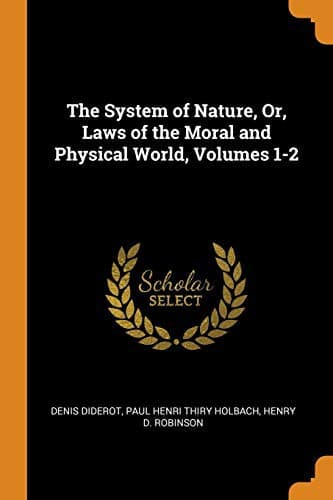
The System of Nature, or, the Laws of the Moral and Physical World. Volume 1Holbach, Paul Henri Thiry, baron d'
Religion
The System of Nature, or, the Laws of the Moral and Physical World. Volume 1
Holbach, Paul Henri Thiry, baron d'
Materialism; Philosophy and religion; Psychology
The heart of man is a soil which Nature has made equally suitable to the
production of brambles, or of useful grain--of deleterous poison, or of
refreshing fruit, by virtue of the seeds which may be sown in it--by the
cultivation that may be bestowed upon it, In his infancy, those objects
are pointed out to him which he is to estimate or to despise, to
seek after or to avoid, to love or to hate. It is his parents,
his instructors, who render him either virtuous or wicked, wise or
unreasonable, studious or dissipated, steady or trifling, solid or
vain. Their example, their discourse, modify him through his whole life,
teaching him what are the things he ought either to desire or to avoid;
what the objects he ought to fear or to love: he desires them, in
consequence; and he imposes on himself the task of obtaining them,
according to the energy of his temperament, which ever decides the
force of his passions. It is thus that education, by inspiring him with
opinions, by infusing into him ideas, whether true or false, gives
him those primitive impulsions after which he acts, in a manner either
advantageous or prejudicial both to himself and to others. Man, at
his birth, brings with him into the world nothing but the necessity
of conserving himself, of rendering his existence happy: instruction,
example, the customs of the world, present him with the means, either
real or imaginary, of achieving it; habit procures for him the facility
of employing these means: he attaches himself strongly to those he
judges best calculated, most proper to secure to him the possession of
those objects which they have taught him, which he has learned to
desire as the preferable good attached to his existence. Whenever his
education--whenever the examples which have been afforded him--whenever
the means with which he has been provided, are approved by reason, are
the result of experience, every thing concurs to render him virtuous;
habit strengthens these dispositions in him; he becomes, in consequence,
a useful member of society; to the interests of which, every thing ought
to prove to him his own permanent well-being, his own durable felicity,
is necessarily allied. If, on the contrary, his education--his
institutions--the examples which are set before him--the opinions which
are suggested to him in his infancy, are of a nature to exhibit to his
mind virtue as useless and repugnant--vice as useful and congenial to
his own individual happiness, he will become vicious; he will believe
himself interested in injuring society, in rendering his associates
unhappy; he will be carried along by the general current: he will
renounce virtue, which to him will no longer be any thing more than
a vain idol, without attractions to induce him to follow it; without
charms to tempt his adoration; because it will appear to exact, that he
should immolate at its shrine, that he should sacrifice at its altar all
those objects which he has been constantly taught to consider the most
Public-domain text, read in full here on John Shaqi.
Reviews
Reviews
No reviews yet
Be the first to share your thoughts on this work.
Elsewhere in the archive
Join the Discussion
Join the discussion
Sign in to leave a comment or review.
Sign InorCreate an account