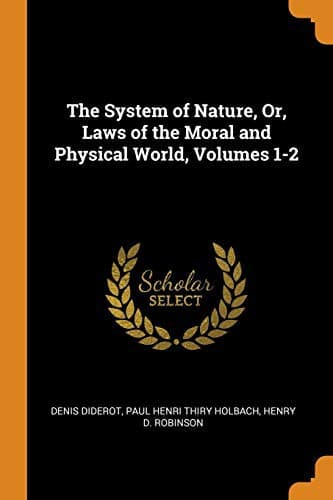
The System of Nature, or, the Laws of the Moral and Physical World. Volume 1Holbach, Paul Henri Thiry, baron d'
Religion
The System of Nature, or, the Laws of the Moral and Physical World. Volume 1
Holbach, Paul Henri Thiry, baron d'
Materialism; Philosophy and religion; Psychology
dear to himself; to contemplate as benefits the most desirable.
In order that man may become virtuous, it is absolutely requisite that
he should have an interest, that he should find advantages in practising
virtue. For this end, it is necessary that education should implant in
him reasonable ideas; that public opinion should lean towards virtue, as
the most desirable good; that example should point it out as the object
most worthy esteem; that government should faithfully recompense, should
regularly reward it; that honor should always accompany its practice;
that vice should constantly be despised; that crime should invariably be
punished. Is virtue in this situation amongst men? does the education of
man infuse into him just, faithful ideas of happiness--true notions of
virtue--dispositions really favourable to the beings with whom he is to
live? The examples spread before him, are they suitable to innocence and
manners? are they calculated to make him respect decency--to cause him
to love probity--to practice honesty--to value good faith--to esteem
equity--to revere conjugal fidelity--to observe exactitude in fulfilling
his duties? Religion, which alone pretends to regulate his manners, does
it render him sociable--does it make him pacific--does it teach him to
be humane? The arbiters, the sovereigns of society, are they faithful
in recompensing, punctual in rewarding, those who have best served their
country? in punishing those who have pillaged, who have robbed, who have
plundered, who have divided, who have ruined it? Justice, does she hold
her scales with a firm, with an even hand, between all the citizens
of the state? The laws, do they never support the strong against the
weak--favor the rich against the poor--uphold the happy against the
miserable? In short, is it an uncommon spectacle to behold crime
frequently justified, often applauded, sometimes crowned with success,
insolently triumphing, arrogantly striding over that merit which it
disdains, over that virtue which it outrages? Well then, in societies
thus constituted, virtue can only be heard by a very small number of
peaceable citizens, a few generous souls, who know how to estimate its
value, who enjoy it in secret. For the others, it is only a disgusting
object; they see in it nothing but the supposed enemy to their
happiness, or the censor of their individual conduct.
Public-domain text, read in full here on John Shaqi.
Reviews
Reviews
No reviews yet
Be the first to share your thoughts on this work.
Elsewhere in the archive
Join the Discussion
Join the discussion
Sign in to leave a comment or review.
Sign InorCreate an account