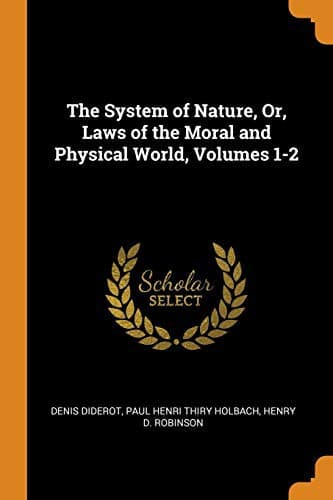
The System of Nature, or, the Laws of the Moral and Physical World. Volume 1Holbach, Paul Henri Thiry, baron d'
Religion
The System of Nature, or, the Laws of the Moral and Physical World. Volume 1
Holbach, Paul Henri Thiry, baron d'
Materialism; Philosophy and religion; Psychology
It has been believed man was a free agent, because it has been imagined
that his soul could at will recall ideas, which sometimes suffice
to check his most unruly desires. Thus, the idea of a remote evil
frequently prevents him from enjoying a present and actual good: thus,
remembrance, which is an almost insensible, a slight modification of his
brain, annihilates, at each instant, the real objects that act upon
his will. But he is not master of recalling to himself his ideas at
pleasure; their association is independent of him; they are arranged in
his brain, in despite of him, without his own knowledge, where they have
made an impression more or less profound; his memory itself depends upon
his organization; its fidelity depends upon the habitual or momentary
state in which he finds himself; when his will is vigorously determined
to some object or idea that excites a very lively passion in him, those
objects or ideas that would be able to arrest his action no longer
present themselves to his mind; in those moments his eyes are shut
to the dangers that menace him, of which the idea ought to make him
forbear; he marches forward headlong towards the object by whose image
he is hurried on; reflection cannot operate upon him in any way; he sees
nothing but the object of his desires; the salutary ideas which might be
able to arrest his progress disappear, or else display themselves either
too faintly or too late to prevent his acting. Such is the case with
all those who, blinded by some strong passion, are not in a condition
to recal to themselves those motives, of which the idea alone, in cooler
moments, would be sufficient to deter them from proceeding; the disorder
in which they are, prevents their judging soundly; render them incapable
of foreseeing the consequence of their actions; precludes them from
applying to their experience; from making use of their reason; natural
operations, which suppose a justness in the manner of associating
their ideas; but to which their brain is then not more competent, in
consequence of the momentary delirium it suffers, than their hand is to
write whilst they are taking violent exercise.
Public-domain text, read in full here on John Shaqi.
Reviews
Reviews
No reviews yet
Be the first to share your thoughts on this work.
Elsewhere in the archive
Join the Discussion
Join the discussion
Sign in to leave a comment or review.
Sign InorCreate an account