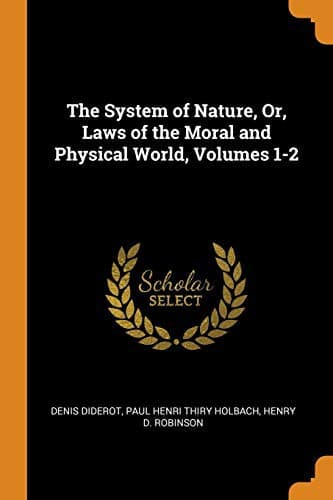
The System of Nature, or, the Laws of the Moral and Physical World. Volume 1Holbach, Paul Henri Thiry, baron d'
Religion
The System of Nature, or, the Laws of the Moral and Physical World. Volume 1
Holbach, Paul Henri Thiry, baron d'
Materialism; Philosophy and religion; Psychology
Man's mode of thinking is necessarily determined by his manner of
being; it must, therefore, depend on his natural organization, and the
modification his system receives independently of his will. From this we
are obliged to conclude, that his thoughts, his reflections, his manner
of viewing things, of feeling, of judging, of combining ideas, is
neither voluntary nor free. In a word, that his soul is neither mistress
of the motion excited in it, nor of representing to itself, when wanted,
those images or ideas that are capable of counterbalancing the impulse
it receives. This is the reason why man, when in a passion, ceases to
reason; at that moment reason is as impossible to be heard, as it is
during an extacy, or in a fit of drunkenness. The wicked are never more
than men who are either drunk or mad: if they reason, it is not until
tranquillity is re-established in their machine; then, and not till
then, the tardy ideas that present themselves to their mind, enable them
to see the consequence of their actions, and give birth to ideas,
that bring on them that trouble, which is designated _shame, regret,
remorse_.
The errors of philosophers on the free-agency of man, have arisen from
their regarding his will as the _primum mobile_, the original motive
of his actions; for want of recurring back, they have not perceived the
multiplied, the complicated causes, which, independently of him, give
motion to the will itself, or which dispose and modify his brain, whilst
he himself is purely passive in the motion he receives. Is he the master
of desiring or not desiring an object that appears desirable to him?
Without doubt it will be answered, No: but he is the master of resisting
his desire, if he reflects on the consequences. But, I ask, is he
capable of reflecting on these consequences when his soul is hurried
along by a very lively passion, which entirely depends upon his natural
organization, and the causes by which he is modified? Is it in his power
to add to these consequences all the weight necessary to counterbalance
his desire? Is he the master of preventing the qualities which render an
object desirable from residing in it? I shall be told, he ought to have
learned to resist his passions; to contract a habit of putting a curb on
his desires. I agree to it without any difficulty: but in reply, I again
ask, Is his nature susceptible of this modification? Does his boiling
blood, his unruly imagination, the igneous fluid that circulates in his
veins, permit him to make, enable him to apply true experience in the
moment when it is wanted? And, even when his temperament has capacitated
him, has his education, the examples set before him, the ideas with
which he has been inspired in early life, been suitable to make him
contract this habit of repressing his desires? Have not all these things
rather contributed to induce him to seek with avidity, to make him
actually desire those objects which you say he ought to resist.
Public-domain text, read in full here on John Shaqi.
Reviews
Reviews
No reviews yet
Be the first to share your thoughts on this work.
Elsewhere in the archive
Join the Discussion
Join the discussion
Sign in to leave a comment or review.
Sign InorCreate an account