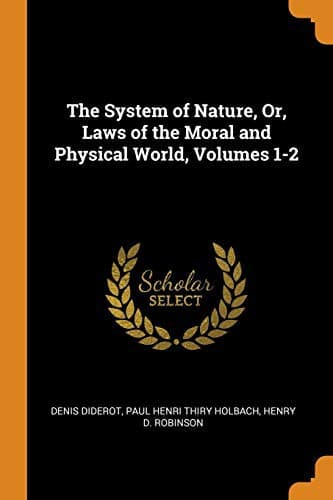
The System of Nature, or, the Laws of the Moral and Physical World. Volume 1Holbach, Paul Henri Thiry, baron d'
Religion
The System of Nature, or, the Laws of the Moral and Physical World. Volume 1
Holbach, Paul Henri Thiry, baron d'
Materialism; Philosophy and religion; Psychology
particular, its individual nature.
CHAP. II.
_Of Motion, and its Origin._
Motion is an effect by which a body either changes, or has a tendency
to change, its position: that is to say, by which it successively
corresponds with different parts of space, or changes its relative
distance to other bodies. It is motion alone that establishes the
relation between our senses and exterior or interior beings: it is only
by motion that these beings are impressed upon us--that we know their
existence--that we judge of their properties--that we distinguish the
one from the other--that we distribute them into classes.
The beings, the substances, or the various bodies of which Nature is
the assemblage, are themselves effects of certain combinations or causes
which become causes in their turn. A CAUSE is a being which puts another
in motion, or which produces some change in it. The EFFECT is the change
produced in one body, by the motion or presence of another.
Each being, by its essence, by its peculiar nature, has the faculty of
producing, is capable of receiving, has the power of communicating, a
variety of motion. Thus some beings are proper to strike our organs;
these organs are competent to receiving the impression, are adequate to
undergoing changes by their presence. Those which cannot act on any of
our organs, either immediately and by themselves, or immediately by the
intervention of other bodies, exist not for us; since they can neither
move us, nor consequently furnish us with ideas: they can neither be
known to us, nor of course be judged of by us. To know an object, is to
have felt it; to feel it, it is requisite to have been moved by it. To
see, is to have been moved, by something acting on the visual organs;
to hear, is to have been struck, by something on our auditory nerves. In
short, in whatever mode a body may act upon us, whatever impulse we may
receive from it, we can have no other knowledge of it than by the change
it produces in us.
Nature, as we have already said, is the assemblage of all the beings,
consequently of all the motion of which we have a knowledge, as well
as of many others of which we know nothing, because they have not yet
become accessible to our senses. From the continual action and re-action
of these beings, result a series of causes and effects; or a chain
of motion guided by the constant and invariable laws peculiar to each
being; which are necessary or inherent to its particular nature--which
make it always act or move after a determinate manner. The different
principles of this motion are unknown to us, because we are in many
instances, if not in all, ignorant of what constitutes the essence of
beings. The elements of bodies escape our senses; we know them only in
the mass: we are neither acquainted with their intimate combination,
nor the proportion of these combinations; from whence must necessarily
result their mode of action, their impulse, or their different effects.
Public-domain text, read in full here on John Shaqi.
Reviews
Reviews
No reviews yet
Be the first to share your thoughts on this work.
Join the Discussion
Join the discussion
Sign in to leave a comment or review.
Sign InorCreate an account