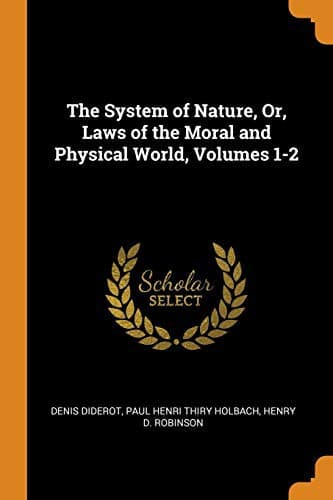
The System of Nature, or, the Laws of the Moral and Physical World. Volume 1Holbach, Paul Henri Thiry, baron d'
Religion
The System of Nature, or, the Laws of the Moral and Physical World. Volume 1
Holbach, Paul Henri Thiry, baron d'
Materialism; Philosophy and religion; Psychology
That is called SIMPLE MOTION, which is excited in a body by a single
cause. COMPOUND MOTION, that which is produced by two or more
different causes; whether these causes are equal or unequal, conspiring
differently, acting together or in succession, known or unknown.
Let the motion of beings be of whatsoever nature it may, it is always
the necessary consequence of their essence, or of the properties which
compose them, and of those causes of which they experience the action.
Each being can only move and act after a particular manner; that is to
say, conformably to those laws which result from its peculiar essence,
its particular combination, its individual nature: in short, from its
specific energies, and those of the bodies from which it receives an
impulse. It is this that constitutes the invariable laws of motion:
I say _invariable_, because they can never change, without producing
confusion in the essence of things. It is thus that a heavy body must
necessarily fall, if it meets with no obstacle sufficient to arrest its
descent; that a sensible body must naturally seek pleasure, and avoid
pain; that fire must necessarily burn, and diffuse light.
Each being, then, has laws of motion, that are adapted to itself, and
constantly acts or moves according to these laws; at least when
no superior cause interrupts its action. Thus, fire ceases to burn
combustible matter, as soon as sufficient water is thrown into it, to
arrest its progress. Thus, a sensible being ceases to seek pleasure, as
soon as he fears that pain will be the result.
The communication of motion, or the medium of action, from one body to
another, also follows certain and necessary laws; one being can only
communicate motion to another, by the affinity, by the resemblance, by
the conformity, by the analogy, or by the point of contact, which it
has with that other being. Fire can only propagate when it finds matter
analogous to itself: it extinguishes when it encounters bodies which it
cannot embrace; that is to say, that do not bear towards it a certain
degree of relation or affinity.
Public-domain text, read in full here on John Shaqi.
Reviews
Reviews
No reviews yet
Be the first to share your thoughts on this work.
Join the Discussion
Join the discussion
Sign in to leave a comment or review.
Sign InorCreate an account