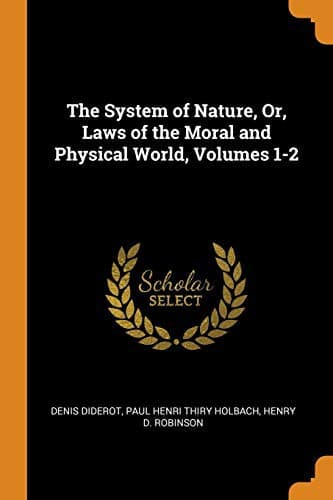
The System of Nature, or, the Laws of the Moral and Physical World. Volume 1Holbach, Paul Henri Thiry, baron d'
Religion
The System of Nature, or, the Laws of the Moral and Physical World. Volume 1
Holbach, Paul Henri Thiry, baron d'
Materialism; Philosophy and religion; Psychology
Let the man of humanity, whose tender feelings are alive to the welfare
of his species--let the moralist, who preaches virtue, who holds out
forbearance to man--let the philosopher, who dives into the secrets of
Nature--let the theologian himself say, if this dreadful iniquity, this
heinous sin, does not become yet more crying, when the laws decree the
most cruel tortures for crimes to which the most irrational customs gave
birth--which bad institutions engender--which evil examples multiply? Is
not this something like building a sorry, inconvenient hovel, and then
punishing the inhabitant, because he does not find all the conveniences
of the most complete mansion, of the most finished structure? Man, as
at cannot be too frequently repeated, is so prone to evil, only because
every thing appears to urge him on to the commission of it, by too
frequently shewing him vice triumphant: his education is void in a great
number of states, perhaps defective in nearly all; in many places
he receives from society no other principles, save those of an
unintelligible superstition; which make but a feeble barrier against
those propensities that are excited by dissolute manners; which are
encouraged by corrupt examples: in vain the law cries out to him:
"abstain from the goods of thy neighbour;" his wants, more powerful,
loudly declare to him that he must live: unaccustomed to reason, having
never been submitted to a wholesome discipline, he conceives he must
do it at the expence of a society who has done nothing for him: who
condemns him to groan in misery, to languish in indigence: frequently
deprived of the common necessaries requisite to support his existence,
which his essence, of which he is not the master, compels him to
conserve. He compensates himself by theft, he revenges himself by
assassination, he becomes a plunderer by profession, a murderer by
trade; he plunges into crime, and seeks at the risque of his life, to
satisfy those wants, whether real or imaginary, to which every thing
around him conspires to give birth. Deprived of education, he has
not been taught to restrain the fury of his temperament--to guide his
passions with discretion--to curb his inclinations. Without ideas of
decency, destitute of the true principles of honour, he engages in
criminal pursuits that injure his country: which at the same time has
been to him nothing more than a step-mother. In the paroxysm of his
rage, in the exacerbation of his mind, he loses sight of his neighbour's
rights, he overlooks the gibbet, he forgets the torture; his unruly
desires have become too potent--they have completely absorbed his mind;
by a criminal indulgence they have given an inveteracy to his habits
which preclude him from changing them; laziness has made him torpid:
remorse has gnawed his peace; despair has rendered him blind; he rushes
on to death; and society is compelled to punish him rigorously, for
those fatal, those necessary dispositions, which it has perhaps itself
Public-domain text, read in full here on John Shaqi.
Reviews
Reviews
No reviews yet
Be the first to share your thoughts on this work.
Elsewhere in the archive
Join the Discussion
Join the discussion
Sign in to leave a comment or review.
Sign InorCreate an account