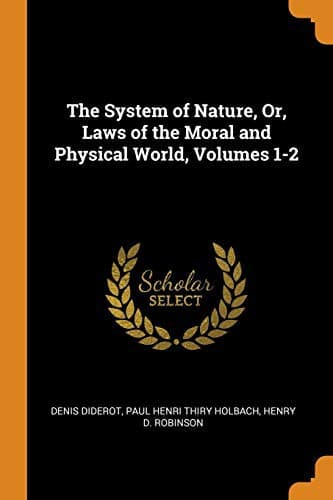
The System of Nature, or, the Laws of the Moral and Physical World. Volume 1Holbach, Paul Henri Thiry, baron d'
Religion
The System of Nature, or, the Laws of the Moral and Physical World. Volume 1
Holbach, Paul Henri Thiry, baron d'
Materialism; Philosophy and religion; Psychology
In Holbach's critique the point at which theology split off from
mythology marks the moment of nature's alienation from itself and paves
the way for man's alienation from nature.
Holbach is thus significant for Romantic interest in myth in two ways.
First, he provides a clear statement of what can be loosely called the
antimythic position, that rationalist condescension and derogation of
all myth and all religion that was never far from the surface during
the Romantic era. Holbach was and is a reminder that the Romantic
affirmation of myth was never easy, uncritical, or unopposed. Any new
endorsement of myth had to be made in the teeth of Holbach and the other
skeptics. The very vigor of the Holbachian critique of myth impelled the
Romantics to think more deeply and defend more carefully any new claim
for myth. Secondly, although Holbach's argument generally drove against
myth and religion both, he did make an important, indeed a saving
distinction between mythology and theology. Mythology is the more or
less harmless personification of the power in and of nature; theology
concerns itself with what for Holbach was the nonexistent power beyond
or behind nature. By exploiting this distinction it would
become possible for a Shelley, for example, to take a strong
antitheological--even an anti-Christian--position without having to
abandon myth.
Holbach was one of William Godwin's major sources for his ideas about
political justice, and Shelley, who discussed Holbach with Godwin,
quotes extensively from _The System of Nature_ in _Queen Mab_.
Furthermore, Volney's _Ruins_, another important book for Shelley,
is directly descended from _The System of Nature_. On the other side,
Holbach was a standing challenge to such writers as Coleridge and Goethe
and was reprinted and retranslated extensively in America, where his
work was well known to the rationalist circle around Jefferson and
Barlow.
Issued in 1770 as though by Jean Baptiste de Mirabaud (a former
perpetual secretary to the Académie française who had died ten years
before), _La Système de la nature_ was translated and reprinted
frequently. The Samuel Wilkinson translation we have chosen to reprint
was the most often reprinted or pirated version in English. A useful
starting point for Holbach's work is Jerome Vercruysse, _Bibliographie
descriptive des écrits du baron d'Holbach_ (Paris, 1971). The difficult
subject of the essentially clandestine evolution of biblical criticism
as an anti-Christian and antimyth critique in the early part of the
eighteenth century, before the well-documented era of the biblical
critic Eichhorn in Germany, is illuminated in Ira Wade, _The Clandestine
Organization and Diffusion of Philosophic Ideas in France from
1700-1750_ (Princeton Univ. Press, 1938).
Robert D. Richardson, Jr.
University of Denver
* * * * *
{Illustration: Parke sculp't M. DE MIRABAUD}
THE SYSTEM OF NATURE; OR, _THE LAWS_ OF THE MORAL AND PHYSICAL WORLD.
Public-domain text, read in full here on John Shaqi.
Reviews
Reviews
No reviews yet
Be the first to share your thoughts on this work.
Join the Discussion
Join the discussion
Sign in to leave a comment or review.
Sign InorCreate an account