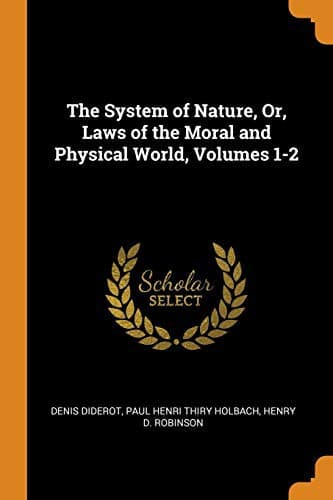
The System of Nature, or, the Laws of the Moral and Physical World. Volume 1Holbach, Paul Henri Thiry, baron d'
Religion
The System of Nature, or, the Laws of the Moral and Physical World. Volume 1
Holbach, Paul Henri Thiry, baron d'
Materialism; Philosophy and religion; Psychology
Observation and reflection ought to convince us, that every thing in
Nature is in continual motion--that there is not a single part, however
small, that enjoys repose--that Nature acts in all--that she would cease
to be Nature if she did not act. Practical knowledge teaches us, that
without unceasing motion, nothing could be preserved--nothing could
be produced--nothing could act in this Nature. Thus the idea of Nature
necessarily includes that of motion. But it will be asked, and not a
little triumphantly, from whence did she derive her motion? Our reply
is, we know not, neither do they--that _we_ never shall, that _they_
never will. It is a secret hidden from us, concealed from them, by the
most impenetrable veil. We also reply, that it is fair to infer, unless
they can logically prove to the contrary, that it is in herself, since
she is the great whole, out of which nothing can exist. We say this
motion is a manner of existence, that flows, necessarily, out of the
nature of matter; that matter moves by its own peculiar energies; that
its motion is to be attributed to the force which is inherent in itself;
that the variety of motion, and the phenomena which result, proceed from
the diversity of the properties--of the qualities--of the combinations,
which are originally found in the primitive matter, of which Nature is
the assemblage.
Natural philosophers, for the most part, have regarded as inanimate, or
as deprived of the faculty of motion, those bodies which are only
moved by the intervention of some agent or exterior cause; they have
considered themselves justified in concluding, that the matter which
forms these bodies is perfectly inert in its nature. They have not
forsaken this error, although they must have observed, that whenever
a body is left to itself, or disengaged from those obstructions which
oppose themselves to its descent, it has a tendency to fall or to
approach the centre of the earth, by a motion uniformly accelerated;
they have rather chosen to suppose a visionary exterior cause, of which
they themselves had but an imperfect idea, than admit that these bodies
held their motion from their own peculiar nature.
Public-domain text, read in full here on John Shaqi.
Reviews
Reviews
No reviews yet
Be the first to share your thoughts on this work.
Join the Discussion
Join the discussion
Sign in to leave a comment or review.
Sign InorCreate an account