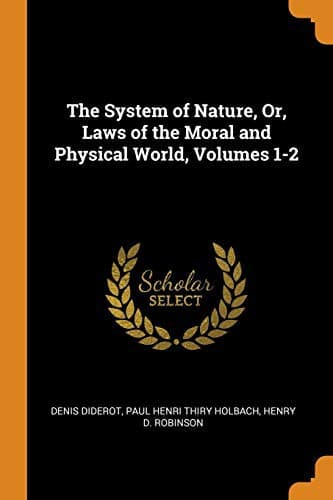
The System of Nature, or, the Laws of the Moral and Physical World. Volume 1Holbach, Paul Henri Thiry, baron d'
Religion
The System of Nature, or, the Laws of the Moral and Physical World. Volume 1
Holbach, Paul Henri Thiry, baron d'
Materialism; Philosophy and religion; Psychology
If attention has been paid to what has been said In the course of this
work, it will be seen that above all it is _education_ that will best
furnish the true means of rectifying the errors, of recalling the
wanderings of mankind. It is this that should scatter the Seeds in
his heart; cultivate the tender shoots; make a profitable use of his
dispositions; turn to account those faculties, which depend on his
organization: which should cherish the fire of his imagination, kindle
it for useful objects; damp it, or extinguish it for others; in short,
it is this which should make sensible souls contract habits which are
advantageous for society and beneficial to the individual. Brought up in
this manner, man would not have occasion for celestial punishments,
to teach him the value of virtue; he would not need to behold burning
gulphs of brimstone under his feet, to induce him to feel horror for
crime; Nature without these fables, would teach much better what he owes
to himself; the law would point out what he owes to the body politic, of
which he is a member. It is thus, that education grounded upon utility,
would form valuable citizens to the state; the depositaries of power
would distinguish those whom education should have thus formed, by
reason of the advantages which they would procure for their country;
they would punish those who should be found injurious to it; it would
make the citizens see, that the promises of reward which education held
forth, the punishments denounced by morals, are by no means vain; that
in a state well constituted, _virtue_ is the true, the only road to
happiness; _talents_ the way to gain respect; that _inutility_ conducts
to misfortune: that _crime_ leads to contempt.
A just, enlightened, virtuous, and vigilant government, who should
honestly propose the public good, would have no occasion either for
fables or for falsehoods, to govern reasonable subjects; it would blush
to make use of imposture, to deceive its citizens; who, instructed in
their duties, would find their interest in submitting to equitable laws;
who would be capable of feeling the benefit these have the power of
conferring on them; it would feel, that habit is sufficient to inspire
them with horror, even for those concealed crimes that escape the eyes
of society; it would understand that the visible punishments of this
world impose much more on the generality of men, than those of an
uncertain and distant futurity: in short, it would ascertain that
the sensible benefits within the compass of the sovereign power to
distribute, touch the imagination of mortals more keenly, than those
vague recompences which are held forth to them in a future existence:
above all, it would discover that those on whom these distant advantages
do operate, would be still more attached to virtue by receiving their
reward both here and hereafter.
Public-domain text, read in full here on John Shaqi.
Reviews
Reviews
No reviews yet
Be the first to share your thoughts on this work.
Elsewhere in the archive
Join the Discussion
Join the discussion
Sign in to leave a comment or review.
Sign InorCreate an account