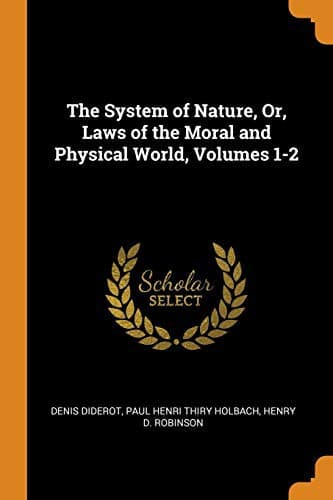
The System of Nature, or, the Laws of the Moral and Physical World. Volume 1Holbach, Paul Henri Thiry, baron d'
Religion
The System of Nature, or, the Laws of the Moral and Physical World. Volume 1
Holbach, Paul Henri Thiry, baron d'
Materialism; Philosophy and religion; Psychology
If the covenant which unites man to society be considered, it will be
obvious that every contract is conditional, must be reciprocal; that is
to say, supposes mutual advantages between the contracting parties. The
citizen cannot be bound to his country, to his associates, but by the
bonds of happiness. Are these bonds cut asunder? He is restored to
liberty. Society, or those who represent it, do they use him with
harshness, do they treat him with injustice, do they render his
existence painful? Does disgrace hold him out to the finger of scorn;
does indigence menace him in an obdurate world? Perfidious friends, do
they forsake him in adversity? An unfaithful wife, does she outrage his
heart? Rebellious, ungrateful children, do they afflict his old age?
Has he placed his happiness exclusively on some object which it is
impossible for him to procure? Chagrin, remorse, melancholy, and
despair, have they disfigured to him the spectacle of the universe? In
short, for whatever cause it may be: if he is not able to support
his evils, he quits a world, which from henceforth, is for him only a
frightful desert he removes himself for ever from a country he thinks
no longer willing to reckon him amongst the number of her children--he
quits a house that to his mind is ready to bury him under its ruins--he
renounces a society, to the happiness of which he can no longer
contribute; which his own peculiar felicity alone can render dear to
him: and could the man be blamed, who, finding himself useless; who
being without resources, in the town where destiny gave him birth,
should quit it in chagrin, to plunge himself in solitude? Death appears
to the wretched the only remedy for despair; it is then the sword seems
the only friend, the only comfort that is left to the unhappy: as long
as hope remains the tenant of his bosom--as long as his evils appear to
him at all supportable--as long as he flatters himself with seeing them
brought to a termination--as long as he finds some comfort in existence,
however slender, he will not consent to deprive himself of life: but
when nothing any longer sustains in him the love of this existence, then
to live, is to him the greatest of evils; to die, the only mode by which
he can avoid the excess of despair. This has been the opinion of many
great men: Seneca, the moralist, whom Lactantius calls the divine Pagan,
who has been praised equally by St. Austin and St. Augustine, endeavours
by every kind of argument to make death a matter of indifference to man.
Cato has always been commended, because he would not survive the cause
of liberty; for that he would not live a slave. Curtius, who rode
voluntarily into the gap, to save his country, has always been held
forth as a model of heroic virtue. Is it not evident, that those martyrs
who have delivered themselves up to punishment, have preferred quitting
the world to living in it contrary to their own ideals of happiness?
Public-domain text, read in full here on John Shaqi.
The System of Nature, or, the Laws of the Moral and Physical World. Volume 1 — John Shaqi
Reviews
Reviews
No reviews yet
Be the first to share your thoughts on this work.
Elsewhere in the archive
Join the Discussion
Join the discussion
Sign in to leave a comment or review.
Sign InorCreate an account