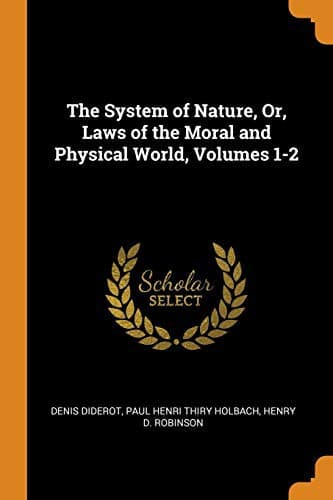
The System of Nature, or, the Laws of the Moral and Physical World. Volume 1Holbach, Paul Henri Thiry, baron d'
Religion
The System of Nature, or, the Laws of the Moral and Physical World. Volume 1
Holbach, Paul Henri Thiry, baron d'
Materialism; Philosophy and religion; Psychology
When Samson wished to be revenged on the Philistines, did he not consent
to die with them as the only means? If our country is attacked, do we
not voluntarily sacrifice our lives in its defence?
That society who has not the ability, or who is not willing to procure
man any one benefit, loses all its rights over him; Nature, when it has
rendered his existence completely miserable, has in fact, ordered him to
quit it: in dying he does no more than fulfil one of her decrees, as
he did when he first drew his breath. To him who is fearless of death,
there is no evil without a remedy; for him who refuses to die, there
yet exists benefits which attach him to the world; in this case let him
rally his powers--let him oppose courage to a destiny that oppresses
him--let him call forth those resources with which Nature yet furnishes
him; she cannot have totally abandoned him, while she yet leaves him the
sensation of pleasure; the hopes of seeing a period to his pains.
Man regulates his judgment on his fellows, only by his own peculiar
mode of feeling; he deems as folly, he calls delirium all those violent
actions which he believes but little commensurate with their causes; or
which appear to him calculated to deprive him of that happiness, towards
which he supposes a being in the enjoyment of his senses, cannot cease
to have a tendency: he treats his associate as a weak creature, when he
sees him affected with that which touches him but lightly; or when he is
incapable of supporting those evils, which his self-love flatters him,
he would himself be able to endure with more fortitude. He accuses with
madness whoever deprives himself of life, for objects that he thinks
unworthy so dear a sacrifice; he taxes him with phrenzy, because he has
himself learned to regard this life as the greatest blessing. It is
thus that he always erects himself into a judge of the happiness of
others--of their mode of seeing--of their manner of feeling: a miser who
destroys himself after the loss of his treasure, appears a fool in
the eyes of him who is less attached to riches; he does not feel, that
without money, life to this miser is only a continued torture; that
nothing in the world is capable of diverting him from his painful
sensations: he will proudly tell you, that in his place he had not done
so much; but to be exactly in the place of another man, it is needful to
have his organization--his temperament--his passions--his ideas; it
is in fact needful to be that other; to be placed exactly in the same
circumstances; to be moved by the same causes; and in this case all men,
like the miser, would sacrifice their life, after being deprived of the
only source of their happiness.
Public-domain text, read in full here on John Shaqi.
Reviews
Reviews
No reviews yet
Be the first to share your thoughts on this work.
Elsewhere in the archive
Join the Discussion
Join the discussion
Sign in to leave a comment or review.
Sign InorCreate an account