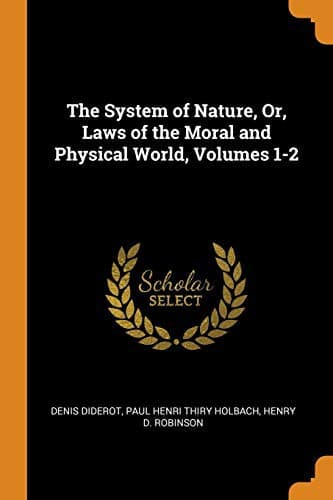
The System of Nature, or, the Laws of the Moral and Physical World. Volume 1Holbach, Paul Henri Thiry, baron d'
Religion
The System of Nature, or, the Laws of the Moral and Physical World. Volume 1
Holbach, Paul Henri Thiry, baron d'
Materialism; Philosophy and religion; Psychology
thing that environs him is ready to partake his pleasures; to share
his pains; cherished, respected, looked up to by others, every thing
conducts him to agreeable reflections; he knows the rights he has
acquired over their hearts; he applauds himself for being the source
of a felicity that captivates all the world; his own condition, his
sentiments of self-love, become an hundred times more delicious when he
sees them participated by all those with whom his destiny has connected
him. The habit of virtue creates for him no wants but those which virtue
itself suffices to satisfy; it is thus that _virtue is always its own
peculiar reward_, that it remunerates itself with all the advantages
which it incessantly procures for others.
It will be said, and perhaps even proved, that under the present
constitution of things, virtue far from procuring the welfare of those
who practice it frequently plunges man into misfortune; often places
continual obstacles to his felicity; that almost every where it is
without recompence. What do I say? A thousand examples could be adduced
as evidence, that in almost every country it is hated, persecuted,
obliged to lament the ingratitude of human nature. I reply with avowing,
that by a necessary consequence of the errors of his race, virtue
rarely conducts man to those objects in which the uninformed make their
happiness consist. The greater number of societies, too frequently ruled
by those whose ignorance makes them abuse their power,--whose prejudices
render them enemies of virtue,--who flattered by sycophants, secure in
the impunity their actions enjoy, commonly lavish their esteem, bestow
their kindness, on none but the most unworthy objects; reward only the
most frivolous, recompence none but the most prejudicial qualities; and
hardly ever accord that justice to merit which is unquestionably its
due. But the truly honest man, is neither ambitious of renumeration, nor
sedulous of the suffrages of a society thus badly constituted: contented
with domestic happiness, he seeks not to augment relations, which would
do no more than increase his danger; he knows that a vitiated community
is a whirlwind, with which an honest man cannot co-order himself: he
therefore steps aside; quits the beaten path, by continuing in which he
would infallibly be crushed. He does all the good of which he is capable
in his sphere; he leaves the road free to the wicked, who are willing
to wade through its mire; he laments the heavy strokes they inflict on
themselves; he applauds mediocrity that affords him security: he pities
those nations made miserable by their errors,--rendered unhappy by those
passions which are the fatal but necessary consequence; he sees they
contain nothing but wretched citizens, who far from cultivating their
true interest, far from labouring to their mutual felicity, far from
feeling the real value of virtue, unconscious how dear it ought to be
to them, do nothing but either openly attack, or secretly injure it;
Public-domain text, read in full here on John Shaqi.
Reviews
Reviews
No reviews yet
Be the first to share your thoughts on this work.
Elsewhere in the archive
Join the Discussion
Join the discussion
Sign in to leave a comment or review.
Sign InorCreate an account