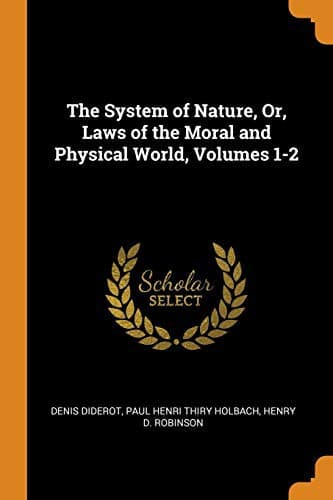
The System of Nature, or, the Laws of the Moral and Physical World. Volume 1Holbach, Paul Henri Thiry, baron d'
Religion
The System of Nature, or, the Laws of the Moral and Physical World. Volume 1
Holbach, Paul Henri Thiry, baron d'
Materialism; Philosophy and religion; Psychology
in short, who detests a quality which would restrain their disorderly
propensities.
In saying that virtue is its own peculiar reward, it is simply meant to
announce, that in a society whose views were guided by truth, trained
by experience, conducted by reason, each individual would be acquainted
with his real interests; would understand the true end of association;
would have sound motives to perform his duties; find real advantages in
fulfilling them; in fact, it would be convinced, that to render himself
solidly happy, he should occupy his actions with the welfare of his
fellows; by their utility merit their esteem, elicit their kindness, and
secure their assistance. In a well-constituted society, the government,
the laws, education, example, would all conspire to prove to the
citizen, that the nation of which he forms a part, is a whole that
cannot be happy, that cannot subsist without virtue; experience would,
at each step, convince him that the welfare of its parts can only result
from that of the whole body corporate; justice would make him feel, that
no society, can be advantageous to its members, where the volition of
wills in those who act, is not so conformable to the interests of the
whole, as to produce an advantageous re-action.
But, alas! by the confusion which the errors of man have carried into
his ideas: virtue disgraced, banished, and persecuted, finds not one
of those advantages it has a right to expect: man is indeed shewn those
rewards for it in a future life, of which he is almost always deprived
in his actual existence. It is thought necessary to deceive, considered
proper to seduce, right to intimidate him, in order to induce him to
follow that virtue which every thing renders incommodious to him; he
is fed with distant hopes, in order to solicit him to practice virtue,
while contemplation of the world makes it hateful to him; he is
alarmed by remote terrors, to deter him from committing evil, which his
associates paint as amiable; which all conspires to render necessary.
It is thus that politics, thus that superstition, by the formation of
chimeras, by the creation of fictitious interests pretend to supply
those true, those real motives which nature furnishes,--which
experience would point out,--which an enlightened government should
hold forth,--which the law ought to enforce,--which instruction should
sanction,--which example should encourage,-which rational opinions would
render pleasant. Man, blinded by his passions, not less dangerous than
necessary, led away by precedent, authorised by custom, enslaved by
habit, pays no attention to these uncertain promises, is regardless of
the menaces held out; the actual interests of his immediate pleasures,
the force of his passions, the inveteracy of his habits, always rise
superior to the distant interests pointed out in his future welfare,
or the remote evils with which he is threatened; which always appear
doubtful, whenever he compares them with present advantages.
Public-domain text, read in full here on John Shaqi.
Reviews
Reviews
No reviews yet
Be the first to share your thoughts on this work.
Elsewhere in the archive
Join the Discussion
Join the discussion
Sign in to leave a comment or review.
Sign InorCreate an account