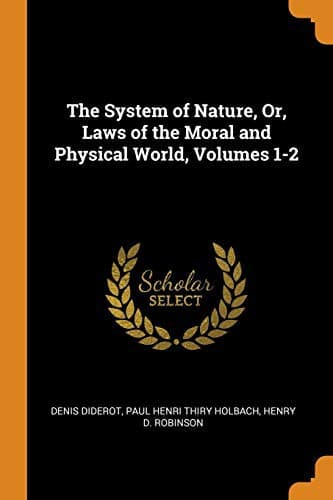
The System of Nature, or, the Laws of the Moral and Physical World. Volume 1Holbach, Paul Henri Thiry, baron d'
Religion
The System of Nature, or, the Laws of the Moral and Physical World. Volume 1
Holbach, Paul Henri Thiry, baron d'
Materialism; Philosophy and religion; Psychology
If, therefore, it be asked, whence came matter? it is very reasonable to
say it has always existed. If it be inquired, whence proceeds the motion
that agitates matter? the same reasoning furnishes the answer; namely,
that as motion is coeval with matter, it must have existed from all
eternity, seeing that motion is the necessary consequence of its
existence--of its essence--of its primitive properties, such as its
extent, its gravity, its impenetrability, its figure, &c. By virtue
of these essential constituent properties, inherent in all matter, and
without which it is impossible to form an idea of it, the various matter
of which the universe is composed must from all eternity have
pressed against, each other--have gravitated towards a center--have
clashed--have come in contact--have been attracted--have been
repelled--have been combined--have been separated: in short, must have
acted and moved according to the essence and energy peculiar to each
genus, and to each of its combinations.
Existence supposes properties in the thing that exists: whenever it
has properties, its mode of action must necessarily flow from those
properties which constitute, its mode of being. Thus, when a body is
ponderous, it must fall; when it falls, it must come in collision with
the bodies it meets in its descent; when it is dense, when it is solid,
it must, by reason of this density, communicate motion to the bodies
with which it clashes; when it has analogy, when it has affinity with
these bodies, it must be attracted, must be united with them; when it
has no point of analogy with them, it must be repulsed.
From which it may be fairly inferred, that in supposing, as we are under
the necessity of doing, the existence of matter, we must suppose it to
have some kind of properties; from which its motion, or modes of action,
must necessarily flow. To form the universe, DESCARTES asked but matter
and motion: a diversity of matter sufficed for him; variety of motion
was the consequence of its existence, of its essence, of its properties:
its different modes of action would be the necessary consequence of
its different modes of being. Matter without properties would be a mere
nothing; therefore, as soon as matter exists, it must act; as soon as
it is various, it must act variously; if it cannot commence to exist,
it must have existed from all eternity; if it has always existed, it can
never cease to be: if it can never cease to be, it can never cease to
act by its own energy. Motion is a manner of being, which matter derives
from its peculiar existence.
Public-domain text, read in full here on John Shaqi.
Reviews
Reviews
No reviews yet
Be the first to share your thoughts on this work.
Join the Discussion
Join the discussion
Sign in to leave a comment or review.
Sign InorCreate an account